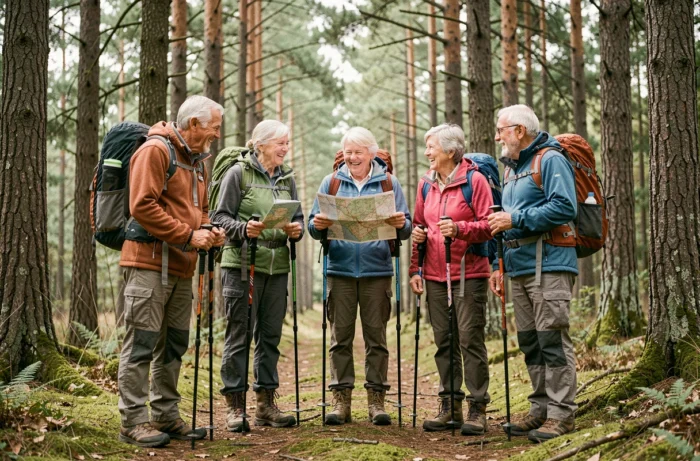
The French Hiking Federation has recorded a notable increase in its licenses among those over 60, while the 25-59 age group is declining in federal sports. This demographic shift is transforming hiking clubs into social spaces where single seniors are increasingly crossing paths. Hiking in clubs for single seniors reflects a deeper movement, supported by private associations and local public policies.
Senior Hiking and Local Policies Against Isolation
Several local authorities are now incorporating walking into their initiatives to combat the isolation of elderly individuals. Local authorities are now funding walking as a tool for social connection.
The Pays de l’Ourcq, for example, offers an “Active Form Senior” program with two-hour hikes twice a week from mid-September to mid-June. This program was designed based on a local study of the needs of people aged 60 and over.
In Paris, the event “In Sneakers with Paulette,” now in its fifth edition in October 2026, invites walkers to pair up with an isolated elderly person. The format is intergenerational, but it shows a clear trend: walking is becoming an institutional lever against senior loneliness.
These public initiatives offer a concrete advantage for singles: they are free or nearly so, supervised, and do not rely on a “matching” logic that can be off-putting. People come to walk and leave with a network. For those who wish to explore clubs dedicated to meetings between senior hikers, you can visit the Green Seniors website, which lists this type of group outings.
Single Hiking Club: What Distinguishes a Good Group from a Simple Listing
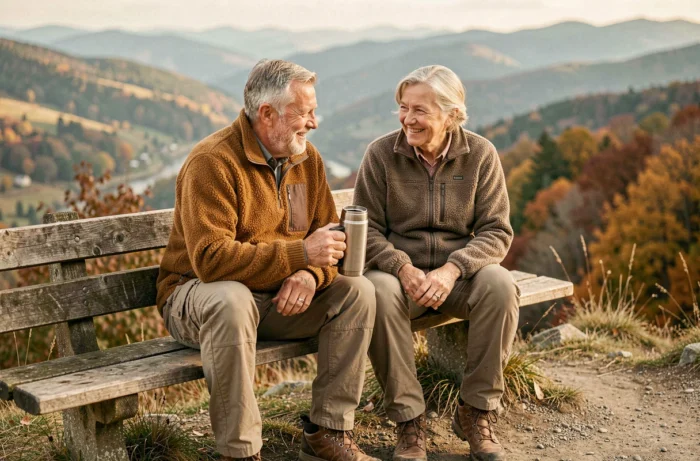
The number of clubs and platforms offering hikes for singles has increased in recent years. Not all operate in the same way, and the quality of supervision makes all the difference in the experience.
Some platforms, like RandoDate, moderate profiles and collect feedback after each outing. Others simply publish a calendar without verification. For a single senior registering for the first time, this distinction is far from trivial.
Concrete Criteria for Evaluating a Senior Hiking Club
- The size of the group: small group outings (eight to twelve participants) encourage real exchanges, whereas a group of thirty resembles more of a tourist excursion
- The displayed difficulty level: a serious club offers several levels (easy, moderate, sporty) and adapts the pace to the participants present, not to a theoretical average
- Frequency: weekly or biweekly outings create a regularity that allows for seeing the same faces and building connections, unlike a one-off event
- Transparent pricing: some clubs charge only the annual membership fee, while others add a cost per outing. Municipal programs are often free and deserve to be explored first
Field feedback diverges on one point: should one prioritize an explicitly “single” club or a mixed club (couples and singles)? Clubs dedicated to singles create an environment where meeting is assumed. In contrast, traditional clubs of the Hiking Federation offer a broader pool and a less “partner-seeking” approach, which is better suited for those who prefer to let things unfold naturally.
Senior Meetings in Nature: Why Walking Works Better than Screens
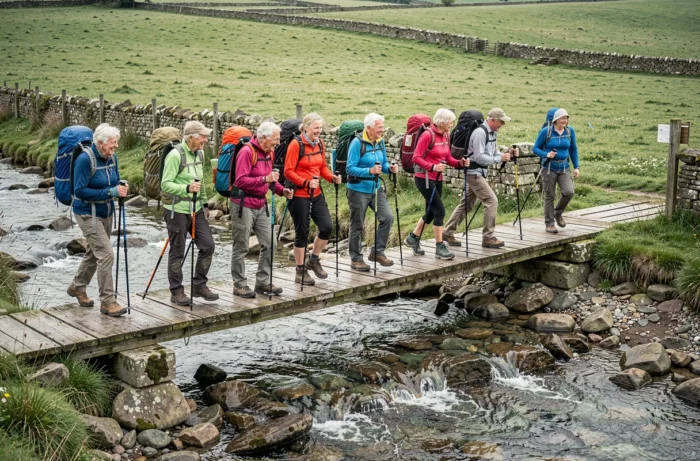
The relational mechanics of hiking rely on a simple element: we walk side by side, not face to face. This physical positioning reduces the social pressure of a “first date” and allows for smoother conversations. Walking removes the artifice of staging found on traditional dating sites.
Another factor plays a role: shared effort. Climbing a trail together, stopping at the same viewpoint, sharing a break creates an immediate bond that online messaging cannot replicate. Hiking clubs for single seniors capitalize on this dynamic by organizing convivial times after the hike (picnics, drinks, visits).
The available data does not allow for quantifying the rate of “couples formed” through these clubs, and the testimonials published on the relevant sites are inherently selective. What is measurable, however, is the documented effect of regular walking on the mental health of seniors. Health insurance explicitly recommends adapted physical activity after age 60, and group hiking checks all the boxes: moderate effort, regularity, social dimension.
Single Senior Hiking Trips: What the Brochures Don’t Specify
Multi-day trips (weekend or full week) are another popular format. They combine the discovery of landscapes in France with immersion in a small group. The principle is appealing, but a few points deserve attention.
- The ratio of walking time to free time varies greatly from one organizer to another: some trips plan four to six hours of daily walking, while others limit it to two hours followed by cultural activities
- Shared accommodation (double rooms assigned among participants of the same sex) can be surprising if not clearly announced in advance
- Trips labeled “meetings” sometimes display a marked gender imbalance, which alters the group dynamic
Checking the detailed program and the expected ratio before booking avoids disappointments. Senior hiker forums are full of useful feedback on this point.
Hiking in a club remains one of the few formats where single seniors can forge connections without going through an algorithm. Whether through a free municipal program or a club dedicated to nature meetings, the principle remains the same: walking together creates a tangible closeness, rooted in the sharing of effort and landscape.