
Sustainable real estate refers to all practices of construction, renovation, and management of a building aimed at reducing its environmental impact throughout its life cycle. In France, the building sector is a major lever for the energy transition due to its weight in final energy consumption and greenhouse gas emissions.
This concept goes beyond mere energy performance. It includes the choice of materials, occupant comfort, resilience to climate change, and the long-term heritage value of the property.
Ban on renting energy-inefficient homes: the game-changing timeline
Since January 1, 2025, homes classified as G in the energy performance diagnosis (DPE) are considered indecent in metropolitan France. They can no longer be put back on the rental market without prior energy renovation work.
The regulatory timeline does not stop there. Homes classified as F will be banned from rental starting in 2028, followed by E in 2034. This gradual pressure forces landlords to anticipate sometimes significant renovation work, under the threat of seeing their property become un-rentable.
One technical point deserves attention: the modification of the DPE calculation rules scheduled for January 1, 2027, is expected to remove approximately 300,000 primary residences and 125,000 rental properties from the “energy-inefficient” category. This recalculation alters the mapping of properties to be renovated, and some owners may postpone work while awaiting this reevaluation. The information available on the La Maison Durable website helps to better understand the responsible housing sectors in this changing context.
MaPrimeRénov’ after September 2026: what the new decree excludes
The decree of August 25, 2026, which came into effect on September 1, 2026, has profoundly reconfigured the “by gesture” pathway of MaPrimeRénov’. Several types of work that were previously eligible are no longer included in this simplified framework.
Specifically, insulation of attics and walls is now excluded from the by gesture pathway. Pellet stoves and individual wood heating equipment have also been removed from the scheme.
This tightening aims to guide households towards comprehensive renovations rather than isolated gestures. The “accompanied” pathway, which finances a coherent bundle of work with significant energy gains, becomes the preferred route by public authorities.
- The by gesture pathway is now limited to a few specific equipment such as air-water or geothermal heat pumps, the removal of oil tanks, and connection to a heating network
- The accompanied pathway requires a prior energy audit and a gain of at least two DPE classes
- Households with the lowest incomes retain higher coverage rates in the accompanied pathway
For a property owner considering only replacing their wood stove, the change in rules requires rethinking the renovation strategy as a whole.
Biosourced materials and low-carbon construction: beyond insulation
RE2020, which came into effect for new constructions, requires accounting for the carbon footprint over the entire life cycle of a building, including the construction phase. This calculation, absent from previous regulations, has made visible the emissions associated with the production of concrete, steel, and synthetic insulators.
Biosourced materials (wood, straw, hemp, cellulose wadding) directly meet this requirement. Wood stores carbon throughout the life of the building, whereas concrete emits it massively during production. Timber construction represents an increasing share of new projects in France, driven by this regulatory framework.
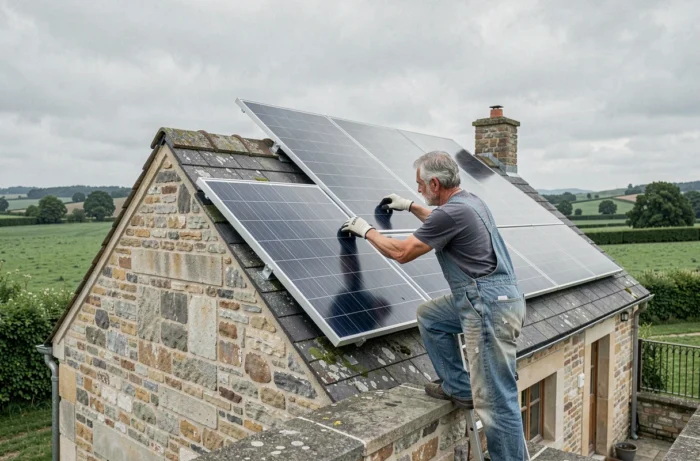
The choice of materials is not limited to the structure. Floor coverings, paints, joinery, and ventilation systems also contribute to indoor air quality. A high-performance ecological habitat combines a low carbon footprint with sanitary comfort for its occupants.
DPE and green value: how energy class affects prices
The DPE is no longer just an administrative document provided during a sale. It now conditions access to the rental market, the amount of renovation aid, and increasingly, the transaction price of a property.
Notaries observe a significant price gap between well-classified homes (A, B, C) and energy-inefficient homes (F, G). This phenomenon, often referred to as “green value,” reflects buyers’ perception of the expected renovation costs and the regulatory risk associated with future rental bans.
- A property classified as F or G is negotiated at a discount compared to an equivalent property classified as D
- Renovated properties with a jump of two DPE classes or more regain attractiveness in the market
- In tight areas, the price effect is mitigated by the scarcity of supply, but the trend remains unfavorable to low labels
For an investor, anticipating renovation before sale or rental allows capturing this green value rather than suffering a discount. The economic calculation includes the cost of work, available aid, and potential gain on the sale price.
Sustainable housing and energy transition: a market structured by regulation
The Climate and Resilience Law, the Tertiary Decree for non-residential buildings, and the ongoing developments of MaPrimeRénov’ outline a framework where responsible real estate is no longer a niche option. Each new regulatory deadline shifts the cursor: what was recommended becomes mandatory, and what was subsidized becomes conditioned on more demanding performances.
The existing stock concentrates the majority of the challenges. Building new in compliance with RE2020 is one thing; renovating several million old homes is another. It is on this second aspect that the coming years will be decisive for the carbon trajectory of the sector in France.