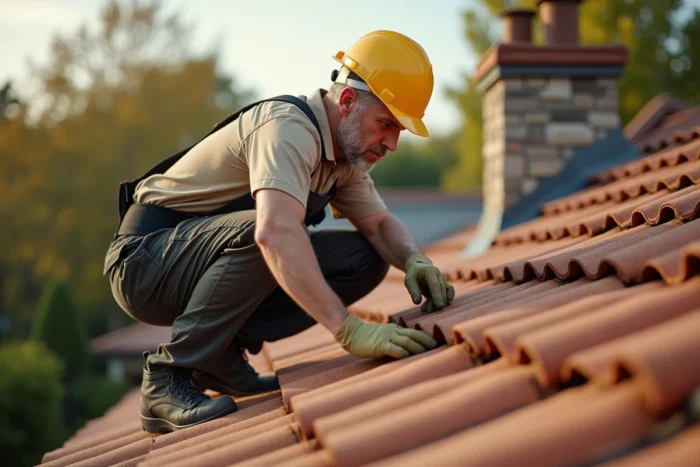
Between two roofs placed on identical houses, the difference in indoor temperature in the middle of summer can reach several degrees. What separates a thermal sieve roof from a high-performance heat-resistant covering rarely comes down to a single factor. Surface color, the phase shift capacity of the insulation, ventilation under the covering: each parameter weighs differently depending on the building configuration. Comparing these variables allows for prioritizing the choices that truly matter for summer comfort.
Thermal phase shift of roof insulations: the criterion that comparisons overlook
Thermal resistance (R) measures an insulation’s ability to slow down heat flow under steady-state conditions. In winter, this is the figure that counts. In summer, the problem changes: solar heat arrives in waves, and what protects the house is the time it takes for this wave to pass through the roof. This time is called thermal phase shift.
An insulation with a high phase shift delays the peak heat by several hours. The overheating that strikes the roof at 2 PM only reaches the interior in the evening, when the outside air has already cooled and natural ventilation can evacuate the residual heat.
| Insulation | Thermal phase shift (for common thickness in roofing) | Summer behavior |
|---|---|---|
| Glass wool | Low (a few hours) | Good winter R, little summer resistance |
| Rock wool | Medium | Slightly better than glass wool due to its density |
| Cellulose wadding | High | Density and inertia significantly delay the peak heat |
| Wood fiber | Very high | Reference for summer comfort in roofing |
| Expanded polystyrene (EPS) | Very low | Performs well in R but is almost transparent to the summer heat wave |
Wood fiber and cellulose wadding stand out clearly for summer comfort. Their high density provides a thermal inertia that lightweight insulations cannot compensate for, even with greater thickness. A roof insulated with polystyrene can show excellent R while allowing the peak heat to pass through in just a few hours.
For those looking for heat-resistant roofing solutions on Habiz, this table highlights why the R value alone is not enough to guarantee summer freshness.

Thermal resistance R and RE2020: the thresholds to aim for in roofing
RE2020, applicable to new constructions, has raised the thermal performance requirements for roofs. Professional guides and recommendations from ADEME converge towards a clear goal: R ≥ 6 to 7 m².K/W for attics, whether in new builds or ambitious renovations. In practice, this corresponds to 30 to 40 cm of insulation depending on the chosen material.
This threshold is not only aimed at limiting winter heat losses. RE2020 includes a summer comfort indicator (DH, degree-hours of discomfort) that penalizes buildings whose roofs allow too much heat to enter. A poorly insulated roof or one insulated with a low phase shift material can meet the minimum R while failing on the summer criterion.
In renovations, there is no regulatory obligation to reach these levels. However, financial aids (MaPrimeRénov’, CEE) are conditioned on R thresholds that progressively align with these values.
Color and reflectivity of the covering: the cool roof effect measured
Even before the heat reaches the insulation, the outer surface of the roof determines what portion of solar radiation is absorbed. A roof with dark tiles can reach very high surface temperatures in summer. In contrast, a light-colored roof or one treated with a reflective coating (cool roof) reflects a large portion of the radiation.
The principle of cool roof is based on albedo, the fraction of sunlight reflected by the surface. The higher the albedo, the less the roof heats up. White or specially formulated reflective coatings achieve albedo levels far superior to those of a standard roof.
- On a flat roof with a black bituminous membrane, applying a cool roof coating can reduce the surface temperature by several tens of degrees compared to the same untreated membrane.
- On a sloped roof with tiles, choosing a light shade rather than a dark one significantly reduces the thermal gains transmitted to the insulation, extending its summer effectiveness.
- Professional buildings (warehouses, workshops, commercial spaces under steel deck) benefit the most from cool roofs, as their roof surface is proportionally very large compared to the interior volume.
The cool roof does not replace insulation. It acts upstream, reducing the thermal load that the insulation must absorb. Combining a reflective coating and high phase shift insulation produces a cumulative effect that neither can achieve alone.

Ventilation under covering and green roofing: two complementary levers
A ventilated air gap between the covering and the insulation evacuates some of the heat before it reaches the insulating material. This system, common on tile roofs with an under-roof screen, improves summer comfort without altering either the insulation or the covering. On roofs without ventilation (bonded sarking, unventilated flat roofs), heat transmits directly, making the choice of insulation even more critical.
Green roofing represents another lever, especially on flat roofs. The layer of substrate and vegetation adds thermal inertia and limits surface heating through evapotranspiration. Green roofs significantly reduce surface temperature peaks, which decreases the strain on the insulation located underneath.
These two approaches (ventilation and greening) do not always appear in material comparisons, even though they concretely modify the thermal behavior of the roof in summer.
The choice of a high-performance roof against heat relies on three parameters to be crossed: high phase shift insulation (wood fiber, cellulose wadding) installed at a sufficient thickness to aim for R 6 to 7 m².K/W, a covering surface with high albedo or light shade, and ventilation or complementary thermal mass suited to the shape of the roof. None of these three elements, taken individually, is sufficient to guarantee indoor freshness during heatwaves.