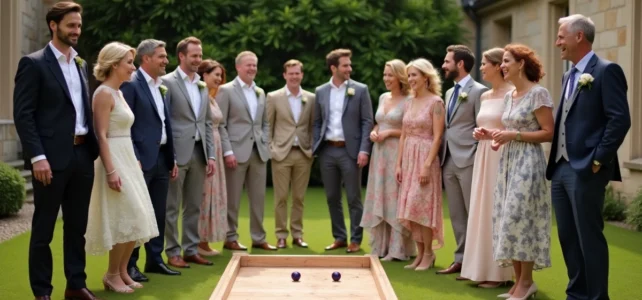
The couple’s photo session often lasts between thirty minutes and an hour. During this time, your guests are left to their own devices at the reception venue or nearby. This gap in the schedule is when boredom sets in, children get restless, and some guests start checking their watches.
Keeping your guests occupied during the wedding photo session is not just a logistical detail: it’s a real lever to ensure that the party maintains its momentum from start to finish.
See also : Where and how to add salt to your pool for optimal treatment
Why the couple’s photo slot creates a lull at the wedding
Have you ever noticed that pause after the ceremony when the couple disappears with the photographer? Guests stand around, drink in hand, unsure of how long the wait will last. This moment is often underestimated during the planning.
The issue doesn’t stem from the absence of the couple itself. It comes from the lack of structure. Without a planned activity, groups fragment: close friends chat among themselves, guests who don’t know each other isolate, and children become unmanageable in less than fifteen minutes. The atmosphere drops, and it then needs to be revived at mealtime.
Further reading : How to Easily Succeed in High School: Essential Tips and Tricks
Anticipating this slot is exactly what the practical tips on Info Mariage detail, with ideas tailored to different reception setups.
Collaborative album via QR code: a self-sustaining photo activity for guests
Instead of letting your guests scroll through Instagram, offer them the chance to contribute to your wedding album. Platforms like Livenly, Invinee, or Love-Album allow you to generate a unique QR code displayed on an easel or printed on the menus.
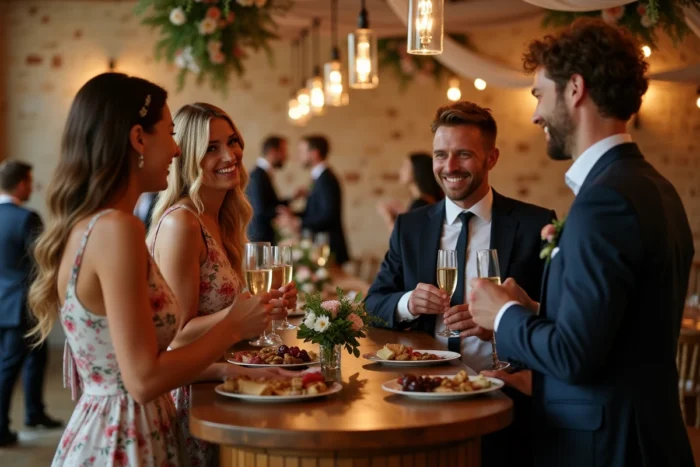
The principle is simple. Each guest scans the code with their smartphone, accesses a dedicated interface, and can post their photos, respond to challenges (for example, “photograph the best hat of the day”), or vote for the best shots. The album builds in real-time while you pose with your photographer.
This type of activity has several concrete advantages:
- It operates without a host or additional equipment, making it compatible with any reception budget.
- It creates a photo thread throughout the wedding, not just during the couple’s photo lull.
- It produces a deliverable: you receive dozens of photos taken from angles that your professional photographer may not capture.
You can display ongoing challenges on a screen or board to encourage participation. The engagement rate increases as soon as there is a visible ranking, even if informal.
Wedding activities to delegate to a provider during the photos
If your budget allows, the photo session slot is the perfect time to introduce a short, targeted service. Some providers specialize in managing these downtime periods, with formats designed to last between thirty and forty-five minutes.
Close-up magic is a format that works particularly well here. A magician circulates from group to group, creating micro-events of three to five minutes per table or circle of guests. Close-up magic requires no stage or sound system, making it discreet and adaptable to a garden or an indoor courtyard.
The silent disco is another option that has started to appear at weddings in recent years. Wireless headphones distributed to guests allow them to dance to several music channels of their choice. The visual effect is quirky, non-dancers are not subjected to noise, and children love the concept.
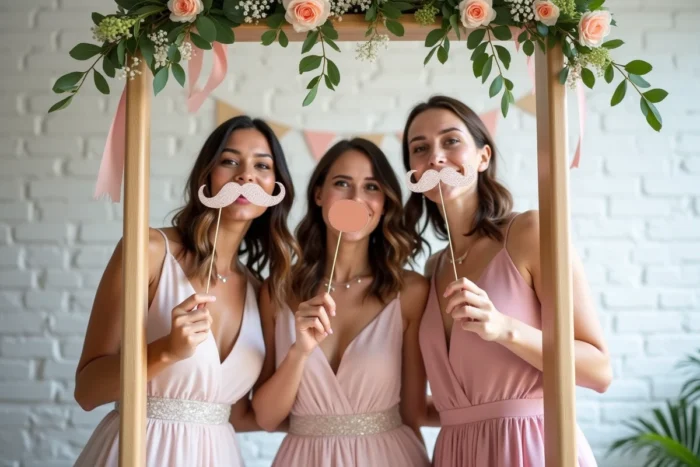
Before booking, ask yourself a practical question: does the activity you are considering work outdoors as well as indoors? A classic photobooth, for example, requires electrical power and a covered space. Check compatibility with your reception venue before signing.
Keeping children occupied at the wedding: a task that should not be overlooked
A four-year-old does not have the same waiting capacity as an adult with a champagne glass. If you have more than a dozen children among your guests, plan a dedicated space with a responsible person.
This doesn’t necessarily have to be a professional babysitter. One or two family teenagers, briefed in advance and equipped with an activity kit, are often sufficient. The idea is to free up parents so they can enjoy the cocktail and activities without constantly watching their children.
Here’s what works well for a kids’ corner:
- A coloring table with drawings related to the wedding (portraits of the couple, venue map) and plenty of crayons.
- Simple outdoor games: bubbles, hula hoops, a DIY tin can knockdown game.
- A reading or cartoon corner on a tablet for the little ones, with headphones so as not to disturb the ambiance.
The kids’ corner doesn’t need to be spectacular. It should be visible (so parents know where to go) and supervised (to prevent anyone from chasing after a child during the best man’s speech).
Coordinating the timing between the photo session and reception activities
The best activity in the world falls flat if it starts too early or too late. Talk to your photographer in advance to know the estimated duration of the couple’s session. Pass this information on to your DJ, caterer, and any entertainment provider.
A simple schedule is enough. If the photo session starts at 5 PM for a duration of forty-five minutes, the cocktail and activities should kick off at exactly 5 PM, not at 5:30 PM when boredom has already set in. The drink service and the start of the activity should coincide with the couple’s departure, not with their return.
Designate a coordinator among your witnesses or close friends. This person doesn’t organize anything complex: they check that the bar is open, that the music is playing, and that the planned activity starts on time. This role prevents the lull that turns a pleasant break into an endless wait.
A wedding where guests have fun during the photo session is also a wedding where the couple returns without guilt. You enjoy your portraits knowing that your loved ones are having a good time, and the transition to the meal happens naturally, without any downtime to make up for.