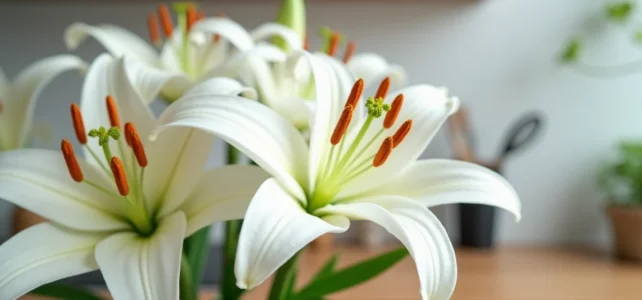
The lily (Lilium) produces a powerful fragrance linked to the emission of volatile organic compounds (VOCs) by its petals. These aromatic molecules are not classified as toxic in the pharmacological sense: inhaling the scent of a lily does not cause poisoning. The confusion often arises from the fact that certain parts of the plant are dangerous if ingested, especially for cats, and that the heady fragrance can be bothersome to sensitive individuals.
Floral VOCs and indoor air quality: the real issue
Most articles on lily toxicity focus on the risk of ingestion by an animal or child. They overlook a more subtle point: the impact of fragrant VOCs on the air in a closed room.
Related reading : Everything You Need to Know About Conditions and Guarantees for Obtaining a Student Loan in 2024
Highly fragrant flowers, such as the oriental lily, continuously release volatile molecules. In a well-ventilated living room, these emissions remain negligible. To understand whether the scent of the lily is toxic to humans, it is important to nuance: the accumulation of fragrant VOCs in a confined space can exacerbate symptoms in individuals already sensitive to respiratory irritants.
This issue is similar to that of scented candles and ambient diffusers, known for emitting irritating particles and VOCs when ventilation is insufficient. The risk does not come from the plant itself, but from the accumulation of VOCs in a reduced air volume.
See also : Everything You Need to Know About the Interior Dimensions of a 10m3 Truck for Your Move

Respiratory symptoms related to lily fragrance
In the majority of healthy adults, a bouquet of lilies in the living room does not cause any notable effects. Those who react are generally individuals who already have a sensitivity to airborne irritants.
The reported manifestations in this context are well identified:
- Headaches appearing after prolonged exposure in a poorly ventilated room, especially at night in a closed bedroom
- Irritative cough and discomfort in the upper respiratory tract, comparable to that triggered by an overly concentrated ambient fragrance
- Worsening of asthma symptoms in asthmatic individuals, with a feeling of chest tightness
- Irritation of the nasal and ocular mucous membranes, sometimes confused with seasonal allergic rhinitis
These symptoms generally disappear quickly once the room is aired out or the bouquet is moved. No acute poisoning has been reported in humans from simple inhalation of lily fragrance.
Lily toxicity from ingestion: distinguishing odor from contact
The confusion between odor and toxicity can be explained by a real fact: the lily contains harmful substances in the case of contact or ingestion. Pollen, petals, leaves, and even the water in the vase can pose problems, but not in the same way depending on the species involved.
Risk for cats and dogs
Cats are by far the most exposed. Ingesting even a tiny amount of lily pollen or petal can cause acute renal failure that can be fatal within days without prompt veterinary care. The urgency is absolute: at the slightest doubt, a call to the veterinarian is imperative.
Dogs are less sensitive, but significant ingestion can still lead to serious digestive issues.
Risk for humans
For adults, putting a lily petal in the mouth does not cause serious poisoning. The risk mainly concerns young children who might chew on parts of the plant: nausea, vomiting, and oral irritation are then possible. The real danger of the lily for humans comes from ingestion, not from inhalation.
Reconstituted lily fragrance and IFRA standards
A rarely discussed angle concerns the lily scents used in perfumery and ambient products. Reconstituted floral fragrances contain synthetic molecules, some of which are on the list of monitored allergens.
Since the 51st amendment of the IFRA (International Fragrance Association), several molecules present in white flower accords (including lily) are subject to usage restrictions or labeling requirements on packaging. These regulatory developments aim to protect consumers with skin or respiratory sensitivities to fragrance allergens.
In other words, a natural bouquet of lilies in a vase raises fewer regulatory questions than a “lily scent” candle whose chemical composition may include controlled allergens.
Concrete precautions with a bouquet of lilies at home
Some simple actions allow you to enjoy a bouquet of lilies indoors without risk:
- Remove the pollen-laden stamens as soon as the flowers open, which reduces both the fragrance and the risk of stains or accidental contact with an animal
- Place the vase in a ventilated room, not in a closed bedroom at night, especially for individuals prone to migraines or asthma
- Keep the bouquet out of reach of cats, including the vase water that concentrates irritating substances
- Choose Asian lily varieties, which are significantly less fragrant than oriental varieties, if sensitivity to fragrance is a concern
Oriental varieties emit the most intense fragrance and are the ones that pose the most problems in confined spaces. Asian lilies, which are almost odorless, are an alternative for sensitive households or those with pets.
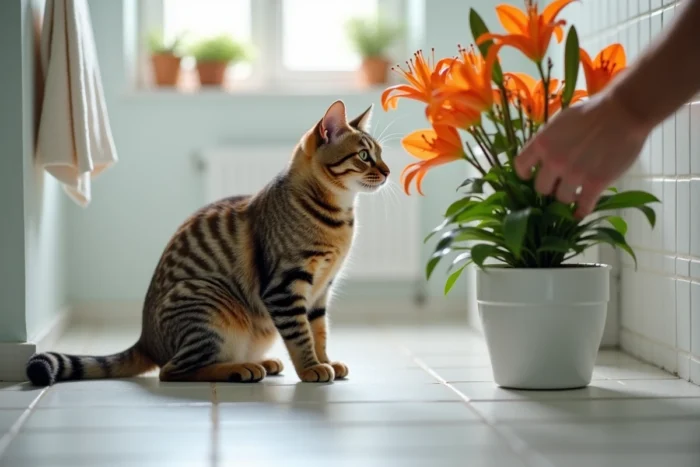
The fragrance of the lily does not pose a classic toxicological risk for humans. The discomfort it may cause is due to the concentration of VOCs in poorly renewed air, a mechanism shared with many other sources of fragrance indoors. The real danger of the lily remains ingestion by cats, a veterinary emergency that does not allow for nuance.