The debate between McDonald’s and Burger King resurfaces with each generation, often reduced to a question of taste or preference for the Whopper or the Big Mac. The answer to the question “who invented modern fast food” deserves a detour through lesser-known facts, as neither truly created the concept of standardized fast food.
White Castle, the forgotten chain that predates McDonald’s and Burger King
Before discussing McDonald’s or Burger King, we must go back to 1916. White Castle, founded in Wichita, Kansas, is considered the first modern fast-food chain. Open kitchens, very low prices, standardized hamburger format: the codes often attributed to the two current giants existed decades before them.
White Castle never reached the size of its successors, but its model laid the groundwork for a restaurant conceived as an industrial system. The extreme standardization of the product, the speed of service, and the affordable price already formed a triptych that McDonald’s would adopt and perfect after World War II.
To understand the history of McDonald’s and Burger King, one must accept that their rivalry is part of an older legacy, where other players had already paved the way.

The Speedee Service System of McDonald’s: a production model, not a restaurant
What distinguishes McDonald’s in the history of fast food is not the burger itself. It’s a complete overhaul of how a restaurant operates, carried out in 1948 by brothers Richard and Maurice McDonald in San Bernardino, California.
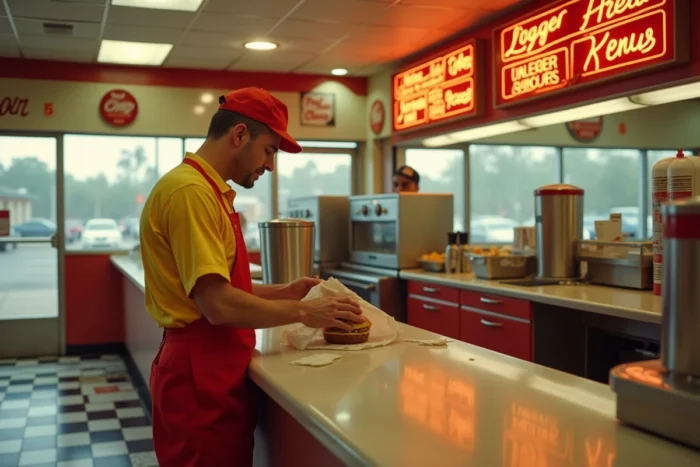
The Speedee Service System was inspired by automobile assembly lines. Each workstation corresponded to a specific task. The menu was reduced to a few products. The customer no longer chose; they received an identical product at each visit. This approach transformed dining into a reproducible large-scale activity.
Ray Kroc, a milkshake machine salesman, recognized the franchise potential of this system. He opened his first McDonald’s restaurant in 1955 and then bought the brand from the founding brothers. It was Kroc who built the global empire, applying the same rigor to business development that the McDonald brothers had applied to the kitchen.
The franchise as an accelerator
The franchise model adopted by Ray Kroc relied on strict control of operations in each restaurant. Franchisees had to follow identical procedures, use the same suppliers, and maintain the same preparation times. McDonald’s sold a production system, not just a brand.
This level of standardization had never been achieved in dining. It allowed for rapid expansion in the United States and then worldwide, creating a model that all competitors later attempted to replicate.
Burger King: a competitor born in the wake of McDonald’s
Burger King opened its first restaurant in Miami in 1953, under the name Insta-Burger King. The founders, Keith Kramer and Matthew Burns, were directly inspired by the McDonald’s model after visiting the San Bernardino restaurant. The lineage is documented and acknowledged.
The brand had a rocky start and changed hands quickly. It was under the leadership of James McLamore and David Edgerton, starting in 1954, that Burger King found its own identity, notably through flame-broiling, which differentiated it from McDonald’s griddle cooking.
- McDonald’s created the standardized production system that defines modern fast food, even before becoming a global franchise.
- Burger King was built in direct reaction to the McDonald’s model, offering an alternative in taste (flame-broiling) and choice (burger customization).
- White Castle had invented the principle of a standardized fast-food chain as early as 1916, long before the two rivals.

Modern fast food: a term that encompasses a system, not a product
Reducing the question to “who invented fast food” often leads to searching for who served the first hamburger quickly. The available data does not allow for a definitive answer regarding a single inventor, because modern fast food is a logistical and commercial system, not a recipe.
This system relies on several interdependent pillars:
- Total product standardization, which ensures identical taste from one restaurant to another, from one country to another.
- The franchise model with centralized operational control, which allows for rapid expansion without managing each point of sale directly.
- Optimization of service time, inherited from industrial methods, which reduces the cost per meal served.
- Mass marketing, which associates the brand with a lifestyle rather than just a meal.
McDonald’s assembled these four elements before anyone else, at a scale that no one had achieved. Burger King followed with a different positioning, focused on taste and customization. Both brands have shaped the fast-food market worldwide, but the matrix of fast food as we know it remains that designed by the McDonald brothers in 1948.
The French case
In France, McDonald’s introduced a fast-food format that was then little known to the French public. Burger King arrived later and even left the French market for several years before returning.
The fast-food landscape in France remains marked by this chronology: McDonald’s as the commercial pioneer, Burger King as an ambitious returnee, and local players who have managed to occupy the vacant spaces.
The economic model of fast food has not fundamentally changed since the 1950s. Recipes evolve, ordering apps multiply, but the basic principle of quickly producing a standardized meal at low cost remains the one that McDonald’s first formalized on a large scale.