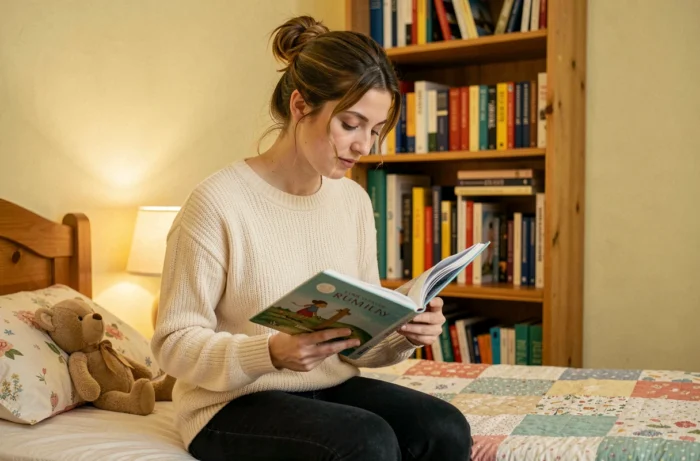
The choice of a bedtime story determines the quality of the wake-sleep transition. A story that is too stimulating reignites cognitive activity, while a text that is too flat does not capture attention long enough to establish muscle relaxation and decreased alertness. We recommend selecting children’s stories to read before sleep based on specific narrative criteria, not just according to the age printed on the cover.
Narrative structure and regulation of excitement before bedtime
An effective bedtime book follows a descending intensity curve. The peak tension occurs in the first third of the story, then the pace gradually slows down to a calm resolution. This pattern mimics the physiological descent into sleep.
Stories with multiple cliffhangers or late twists produce the opposite effect. The child remains alert, asks questions, and requests “just one more page.” A good bedtime book closes without reigniting curiosity.
We observe that the most suitable texts share three narrative characteristics:
- A reassuring initial situation (character in a familiar place, recognizable routine) that allows the child to project themselves without excessive imagination effort.
- A sensory vocabulary oriented towards calm: references to soft touch, muted sounds, benevolent darkness, familiar smells.
- A conclusion that does not leave any unanswered questions or promises of future adventures. The character falls asleep, rests, or reaches a state of tranquility.
Classic tales (Perrault, Grimm) often present a common problem at this level. Their structure frequently includes a late threat (the wolf, the witch) that arises when the child should be in a state of relaxation. Adapting these tales by moving the resolution earlier in the reading can work, but we prefer albums designed from the outset for bedtime reading.
The online catalog of Histoire D’Enfant offers short stories built on this principle of decreasing tension, making the selection process easier for parents.

Bedtime albums for children: titles that work and why
The relevance of a bedtime book does not depend on its popularity but on its internal mechanics. Some albums stand out due to their construction.
“Good Night, Gorilla” by Peggy Rathmann relies almost entirely on the images. The text is limited to “Good night” repeated for each animal. This deliberately impoverished lexical repetition reduces the verbal stimulus and allows the child’s brain to slow down. The parent does not need to modulate their voice: the rhythm is dictated by the pagination.
“I Love You Forever” by Debi Gliori addresses the fear of abandonment, one of the primary causes of resistance to bedtime in children under five. The text progresses through questions and answers between a little fox and its mother, each answer reaffirming emotional security. The anxious child at bedtime finds structured reassurance in it.
“We’re Going on a Bear Hunt” by Michael Rosen works differently. The text is rhythmic, almost sung, with recurring onomatopoeia. It is not a “calm” album in the classic sense, but the hypnotic repetition of the refrain produces a verbal rocking effect. We recommend it for children who need an active phase before winding down.
Bedtime reading for older children: short stories without screens
From the age of six, illustrated albums often lose their appeal. The transition to short stories read aloud by the parent (or read alone) requires a change in format, not principle.
Collections of world tales (African tales, adapted Nordic legends) offer stories of five to ten minutes with an implicit rather than explicit moral. The child reflects without being imposed a lesson, which promotes a peaceful falling asleep rather than one stimulated by an educational injunction.
Screens and audio stories: what recent recommendations change
Recent summaries on the sleep of children aged six to eleven bring a nuance often overlooked. The problem is not the audio content itself but the use of a bright screen in bed. A story listened to via a screenless speaker in a dark room does not produce the same effects as a podcast on a tablet.
Current French recommendations advocate turning off all screens at least one hour before bedtime and not allowing any devices (tablet, smartphone) in the bedroom at night, even for what is deemed educational use. This rule applies even to children’s story apps.
Screenless audio remains a relevant tool in certain specific cases:
- Child who refuses shared reading after a relational conflict during the day. The audio story removes the interpersonal dimension and allows for a return to calm independently.
- Absent parent in the evening (shift work, travel). A recording of the parent’s voice reading a familiar story maintains the ritual without a screen.
- Child over eight in pre-adolescence who rejects the “baby” ritual of shared reading but accepts individual listening.
A common mistake is to let the child choose their audio content alone on a platform. Navigation, selection, and visual thumbnails reignite attention. Preparing the playlist before bedtime eliminates this phase of stimulation.
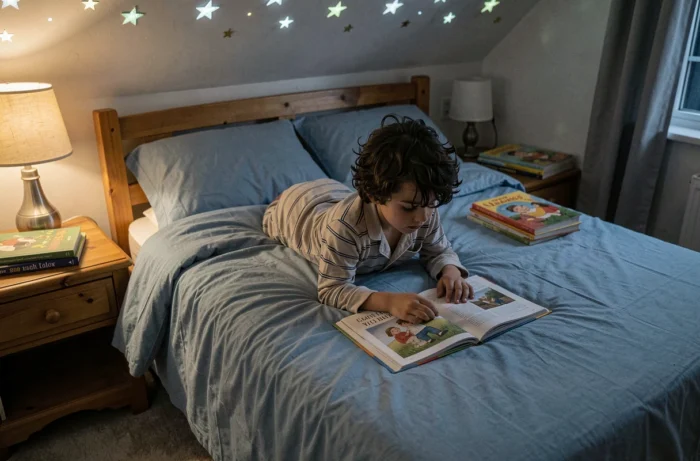
Reading duration and adaptation to the child’s rhythm
A bedtime story that is too long misses its target. The child falls asleep in the middle of the story and does not integrate the calming resolution, or they struggle against sleep to know the ending.
We recommend calibrating the duration based on the child’s usual falling asleep time, not on the length of the book. For a child who falls asleep in ten minutes after the lights go out, a story of five to seven minutes read in a calm voice covers the appropriate window. For a child with a longer falling asleep time, two short stories spaced by a minute of silence are better than a single twenty-minute story.
The reading pace matters as much as the text. Gradually slowing the vocal rhythm as the pages turn, lowering the volume, elongating pauses between sentences: these micro-adjustments transform any decent album into a tool for transitioning to sleep. The bedtime book is not a performance. It is a support towards letting go, and the parent reading is its main instrument.