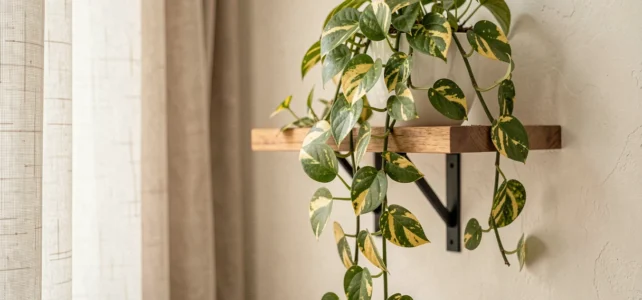
An indoor trailing plant is distinguished by its flexible stems that grow downwards under the influence of gravity, forming cascades of foliage from an elevated point. This natural growth habit allows for the greening of a vertical space (shelf, high furniture, macramé hanging) without taking up any floor space.
The choice of the right species depends on three constraints rarely encountered in the same household: available light, the presence of pets, and the actual time dedicated to maintenance.
Recommended read : Discover the art of hedge trimming to enhance your garden
Toxicity of trailing plants for dogs and cats: the first criterion to check
Most lists of trailing plants highlight pothos, tradescantia, or Rowley’s senecio. However, these three species are toxic to dogs and cats if ingested. Symptoms range from oral irritation to digestive disorders.
For a household with pets, the selection is made before any decorative consideration. Among the compatible trailing plants, chlorophytum (spider plant) remains the reference: its long arching leaves produce runners adorned with plantlets that naturally cascade down. It tolerates missed waterings and poses no documented risk to pets.
Related reading : How to Successfully Cancel Your Home Insurance Efficiently
Another reliable option, peperomia includes several varieties with a trailing habit, featuring fleshy leaves and a compact growth. The creeping fig (Ficus pumila) is also suitable, provided that the chosen variety is not listed among irritating plants for your animal species. By exploring less common natural trailing houseplants, one can find species that combine cascading growth and safety for animals.
Trailing plants for dark interiors: which species really survive in low light
Tolerance to low light does not mean that the plant thrives in darkness. It means that it maintains its growth and foliage with moderate indirect light, typically two to three meters from a north-facing window, or in a room lit by a single opening.
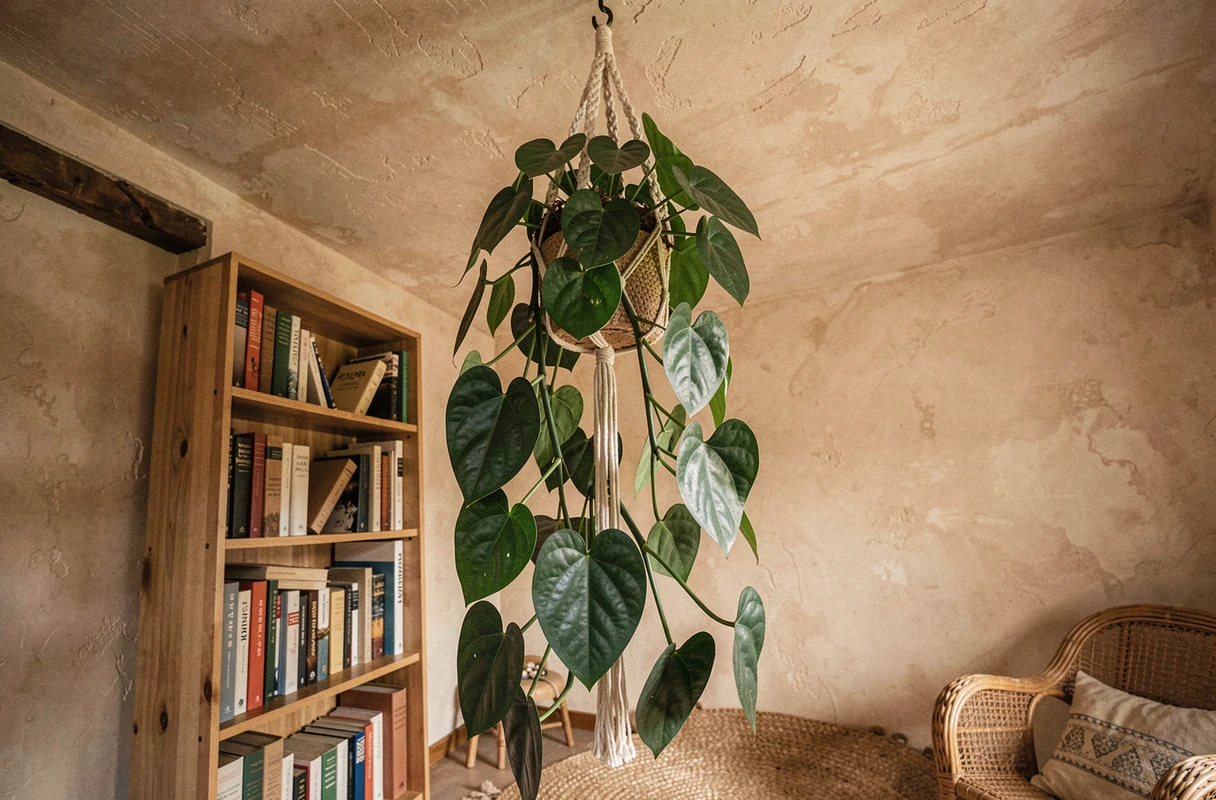
Pothos remains the champion of this category. Its vines continue to elongate even in poorly lit corners, provided one accepts slightly less variegated foliage than in bright light. The philodendron (notably Philodendron scandens) shares this ability, with heart-shaped leaves that cascade down over a meter.
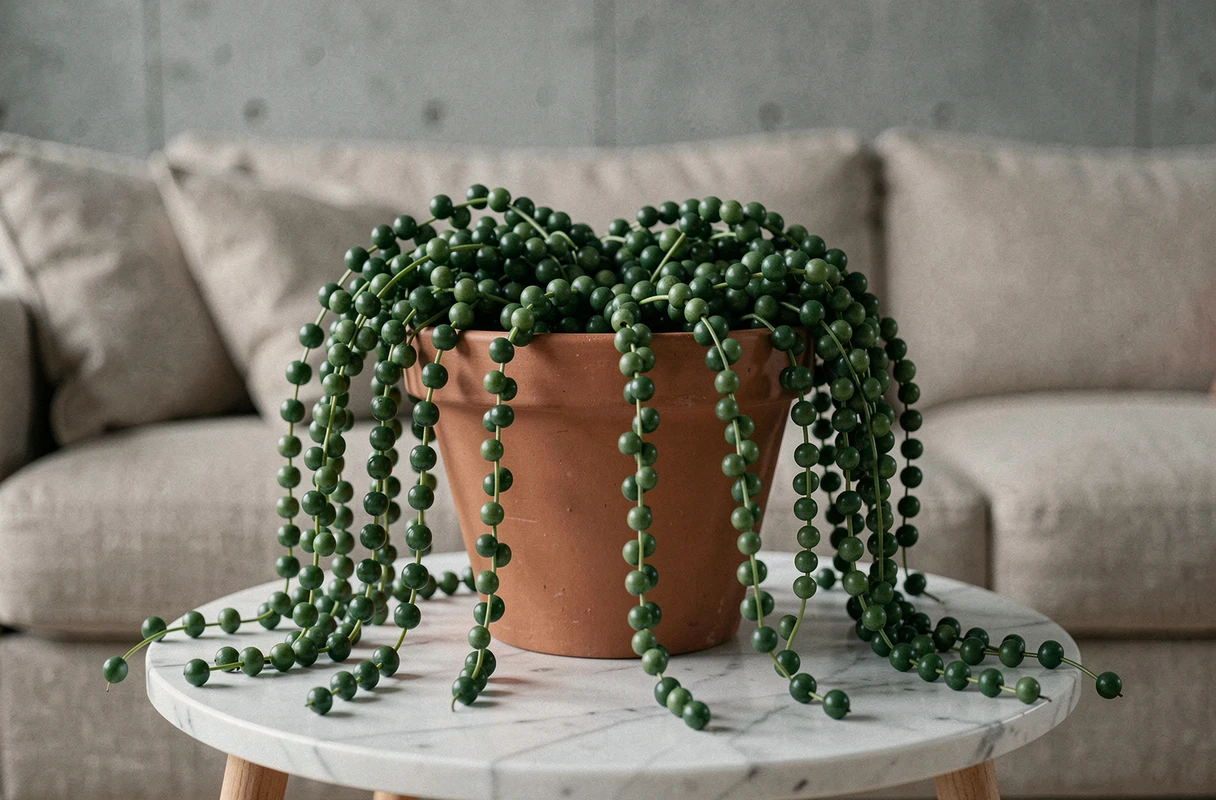
Chlorophytum, already mentioned for its non-toxicity, also tolerates limited lighting. Its growth slows down, but it does not wither. In contrast, the string of hearts (Ceropegia woodii) and Rowley’s senecio require brighter light to maintain their compact growth and avoid becoming leggy.
Adapting the location to the plant’s behavior
A trailing plant placed too far from its light source will produce elongated internodes: the spaces between each leaf stretch, and the vine loses its dense appearance. If this phenomenon occurs, simply move the pot closer to the window by about fifty centimeters.
Turning the pot a quarter turn each week prevents the stems from all growing in the same direction. This action takes a few seconds and significantly improves the plant’s silhouette over the long term.
Minimal care for trailing plants: the actions that really matter
The most common mistake with trailing plants is not under-watering, but over-watering. Positioned high up, these plants are often watered “blindly,” without checking the condition of the substrate. Allowing the potting soil to dry out between waterings remains the basic rule for most trailing species (pothos, philodendron, chlorophytum, peperomia).
The most reliable method is to insert a finger into the soil up to two centimeters. If the soil sticks, postpone watering. If it is dry and crumbly, water until the water drains from the drainage hole.
- In summer, watering every seven to ten days is sufficient for most indoor trailing plants, more if the air is very dry (heating, air conditioning).
- In winter, reduce the frequency of watering by at least one third: growth slows down, roots absorb less water, and the risk of rot increases.
- A pot with a drainage hole and a saucer is preferable to closed cache pots, which trap stagnant water at the bottom.
Fertilization and pruning: two seasonal actions
A diluted liquid fertilizer applied once a month from spring to late summer covers the nutritional needs of most trailing plants. Outside this period, no fertilizer is necessary.
Pruning consists of cutting back stems that are growing too long or losing leaves at the base. This shortening stimulates branching and gives a bushier appearance. Cuttings of pothos or philodendron can be rooted directly in water, allowing for the propagation of plants without additional purchases.
Decoration with trailing plants: utilizing height without cluttering the floor
The main decorative advantage of a trailing plant is that it occupies a volume that is usually empty. The top of a bookshelf, the edge of a wall shelf, a bracket fixed to the ceiling: these locations are rarely utilized in a classic interior.
- On a high piece of furniture, a chlorophytum or pothos in a modest-sized terracotta pot is enough to create a visible cascading plant effect from the sofa.
- In macramé hanging, prefer species with long, flexible stems (pothos, philodendron scandens) whose vines can descend over a meter or more.
- On a narrow shelf, peperomia or string of hearts, being more compact, prevent the foliage from obstructing access to nearby objects.
Varying the heights of installation creates a depth effect that floor plants cannot replicate. Two or three trailing plants placed at different levels in the same room are enough to transform a living room or office.
The choice of pot also matters. A container that is too wide compared to the root ball encourages moisture accumulation. A pot with a diameter exceeding that of the root ball by two to three centimeters offers a good compromise between root space and proper drainage.
Combining a trailing plant with solid foliage (green pothos, philodendron) with a variety that has variegated or colored foliage (zebra tradescantia, marble queen pothos) provides visual contrast without multiplying maintenance constraints, as these species share similar needs for water and light.