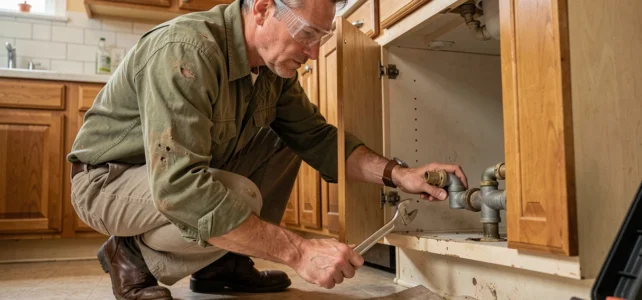
An equipment breakdown rarely generates a technical surprise. In the vast majority of cases, the failure comes from a predictable wear point: porous seal, clogged filter, cracked hose, overheating socket. Maintaining and repairing household equipment relies less on improvised DIY and more on a methodical inspection of the invisible components, those that we forget precisely because they operate silently.
Blackened sockets, hoses, and seals: the failure points to inspect as a priority
The most costly breakdowns arise from elements that we never look at. A wall socket that blackens or feels hot to the touch indicates an internal false contact. Allowing the situation to worsen exposes you to a complete circuit replacement, or even a fire outbreak.
Read also : Discover the essential equipment for all your DIY projects at home
We recommend a semi-annual check of three critical areas on each major connected appliance (washing machine, dishwasher, water heater):
- Water supply hoses: a bulge, a micro-crack, or a whitish trace of limescale at the connection indicates a replacement to be scheduled within a few weeks, not a few months.
- Door and porthole seals: a seal that hardens gradually loses its watertightness. Running a finger along the rubber is enough to detect a crack. The cost of a new seal is negligible compared to water damage.
- Drain and evacuation filters: a clogged filter forces the pump, increases electricity consumption, and shortens the motor’s lifespan. Cleaning it once a quarter takes less than five minutes.
Before any handling, turn off the power at the circuit breaker and check for the absence of voltage remains a non-negotiable prerequisite. This reflex protects both the operator and the appliance.
Further reading : Succeeding in Your Professional Presentation: Strategies and Tips for Impactful Communication
To identify compatible parts for your household appliances, you can consult the home page of SAV 35, which lists common components by brand and category.

Cleaning products and materials: incompatibilities that destroy your equipment
A universal descaler applied to a silicone seal degrades it after a few uses. The incompatibility between cleaning products and materials is a frequent cause of premature failure. Food-grade stainless steel surfaces, non-stick coatings, and elastomer seals each react differently to chemical agents.
Hydrochloric acid, often recommended for stubborn limescale, attacks brass fittings and weakens welds. Concentrated white vinegar, used pure and hot in a washing machine, eventually degrades the internal hoses over cycles.
Adapting cleaning to each surface
On stainless steel kitchen appliances, a mild alkaline product (like diluted baking soda) is sufficient to remove grease without scratching. Natural stone countertops cannot withstand the acidity of lemon or vinegar, which attack the limescale of the material itself.
Testing the product on a non-visible area before any widespread application should be systematic. This precaution applies to the facades of lacquered appliances, PVC window seals, and the enamel surfaces of cooktops.
Home repair or calling a technician: the sorting that avoids mistakes
Not everything can be repaired with a wrench and an online video. Knowing how to distinguish a DIY intervention from a repair that requires a professional determines the longevity of the appliance as much as the safety of the user.
What falls under the user
Replacing external and accessible parts falls within the realm of reasonable DIY:
- Replacing a water supply hose or a shower hose, which only requires a flat wrench and sealing tape.
- Changing a dryer filter, an internal oven lamp, or a water recovery tray.
- Installing anti-vibration feet under a washing machine, an operation that reduces noise and protects the bearings.
- Cleaning the condenser of a refrigerator (back grille), which improves the appliance’s energy efficiency.
These actions require minimal tools and no access to internal electrical components.
What requires a technician
Any intervention on a refrigeration circuit, an electronic board, or a live heating element falls to a professional. Replacing a water heater heating element without mastering the electrical lockout protocol exposes you to the risk of electrocution. Similarly, a refrigerator compressor handled without appropriate equipment releases harmful refrigerant fluid.
The sorting criterion is simple: if the part is behind a screwed cover or requires disassembling the chassis, the risk of breaking an adjacent component or losing the warranty outweighs the financial gain.

Maintenance schedule for equipment: heating, roofing, windows, and facade
Maintaining a home is not limited to appliances. Structural equipment (heating, roofing, windows, facade) follows distinct maintenance cycles, often dictated by the season.
The heating system should be checked before the heating period, not during. On a gas boiler, bleeding the radiators and checking the circuit pressure (the gauge should indicate the value recommended by the manufacturer) prevents breakdowns in the middle of winter when technician response times increase.
The roof deserves a visual inspection after each episode of strong wind or hail. Displaced tiles allow water to enter long before a trace of moisture appears on the ceiling.
Windows and facade: actions often postponed
Window seals lose their flexibility over time. Wiping a cloth soaked in glycerin on rubber seals once a year slows their aging. On the facade side, micro-cracks trap moisture and cause infiltrations that degrade the insulation. Filling a facade crack at the right time costs a fraction of a complete renovation.
A maintenance log for each piece of equipment, even in the form of a simple table, allows you to track interventions and anticipate replacements. The cost of prevention is always less than that of emergency repairs.