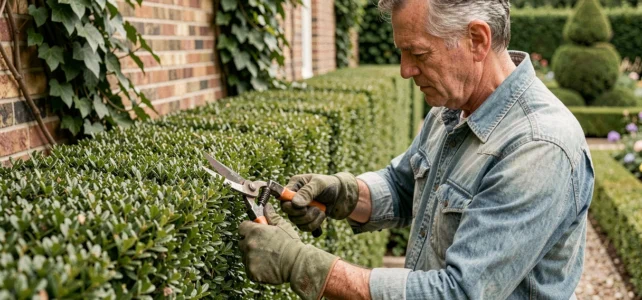
An aging hedge, bare at the base or punctuated with brown holes, cannot be salvaged with a simple maintenance trim. The pruning of hedges on older subjects follows strict physiological rules that we detail here, starting with the most delicate case: the restoration of a partially dead hedge.
Pruning an aging hedge: restoring without condemning regrowth
On an old hedge of thuja or laurels, the common reflex is to cut back severely to “start from scratch.” We discourage this approach. A cut into brown, hard wood increases the risk of permanent holes, as most conifers do not regenerate buds on old wood devoid of green foliage.
Further reading : Discover the key factors of workplace productivity to boost your efficiency
The effective method relies on a gradual restoration. For thuja in particular, severe pruning should be spread over two seasons: we recommend reducing only one side in the first year, then observing the reaction before addressing the other side the following year. This sequencing leaves the shrub with enough leaf surface to ensure photosynthesis and nourish the regrowth.
Before any intervention on a bare hedge, identify the boundary between green wood and dead wood. Run your hand along the branch: where the branches still bear scales or leaves, the cut can trigger a restart. Below that, it’s a lost bet.
See also : Discover natural trailing houseplants to enhance your home decor
For subjects like privet or hornbeam, the margin for maneuver is wider, as deciduous trees can more easily sprout from old wood. Adapting hedge pruning to the species is not a luxury; it is essential for the hedge to survive the intervention.
If your hedge has completely bare areas over more than half its height, the resources offered on sculpte-haie.com can guide the choice of a tool suitable for precision work rather than brutal cutting.
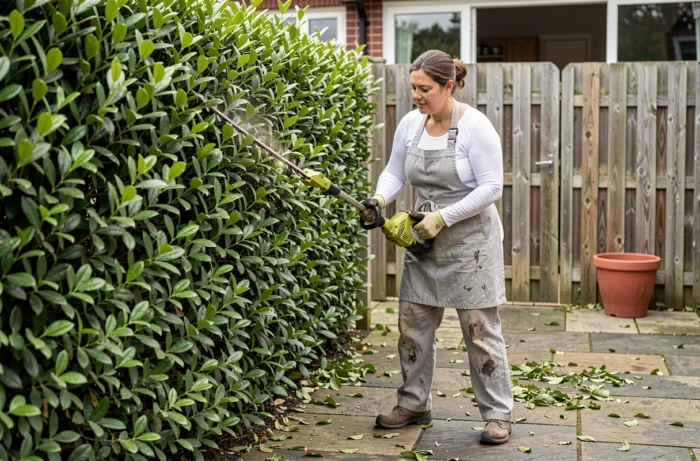
Disinfecting blades between each plant: a neglected protocol
Fungal diseases spread from one shrub to another via cutting blades. This operational point is often absent from the majority of public guides focused on timing and pruning shape.
The procedure is simple but demanding. After each plant (not each hedge, each plant), we wipe the blades with denatured alcohol or a diluted bleach solution. On a hedge of cherry laurels affected by shot hole disease (Coryneum), skipping this step means inoculating the disease along the entire length of the hedge in one session.
This protocol is even more crucial when working on weakened or aging subjects. A shrub already stressed by restorative pruning does not have the resources to fight a simultaneous fungal infection.
Nesting and legal framework before pruning a hedge
Checking for the absence of occupied nests in the hedge before any intervention, including light pruning, is part of good practice. Beyond ecological common sense, destroying nests of protected species exposes one to penalties.
A quick visual check is not always sufficient: some songbirds nest deep within the vegetation. We regularly observe blackbird or blackcap nests positioned at mid-height, invisible from outside the hedge. The most reliable method is to gently part the branches at several points before starting the tool.
- Check at eye level and mid-height, gently parting the branches without forcing, at least at one point every two meters.
- If an occupied nest is spotted, postpone the intervention by several weeks, until the chicks leave the nest.
- Prefer training cuts at the end of summer or in autumn, when the nesting period is over for most species.
Progressive cutting in topiary: a technique distinct from regular maintenance
Topiary pruning is not just about “shaping.” It relies on progressive cuts with regular retreat to control the overall silhouette, which fundamentally differentiates it from the linear maintenance of a straight hedge.
Specifically, each cutting pass removes a few centimeters, then the operator steps back several meters to assess symmetry before continuing. This constant back-and-forth between close cutting and overall vision is the key to a clean result. A classic hedge trimmer with a long blade is not suitable: a short-blade sculpting trimmer offers the necessary maneuverability for curves and angles.
Species that tolerate topiary
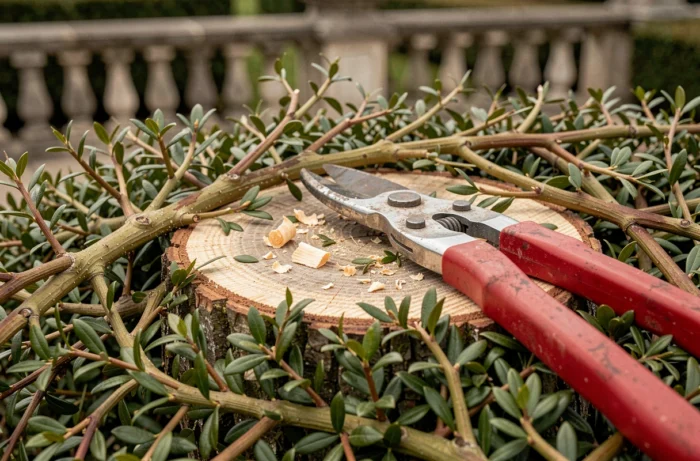
Not all shrubs can withstand repeated shaping. Boxwood, yew, and privet respond well due to their dense branching and ability to regrow on old wood. Cherry laurel, on the other hand, produces broad leaves that, once cut in half by the blade, turn brown and give a neglected appearance. For this species, we recommend cutting with hand pruners branch by branch rather than with a hedge trimmer.
- Boxwood and yew: topiary pruning possible two to three times per season, good regeneration.
- Privet: rapid regrowth, suitable for simple geometric shapes.
- Hornbeam: tolerates topiary but loses its leaves in winter, altering the silhouette.
- Thuja: poorly suited to complex topiary, risk of irreversible brown areas on deep cuts.
Hedge pruning, whether aimed at restoring an aging subject or sculpting a precise shape, relies on a prior diagnosis of the species and its health status. Pruning without identifying the boundary of green wood is akin to working blindly. Disinfecting tools and respecting nesting cycles complete a protocol that mere mastery of timing does not cover.