An unsuitable screwdriver damages the screw head, a too-flexible pliers doesn’t grip anything, and a poorly toothed saw tears the wood instead of cutting it. Home DIY equipment is not just a shopping list: it is a set of tools whose quality and complementarity determine the outcome of each job.
Understanding tool families before equipping a workshop
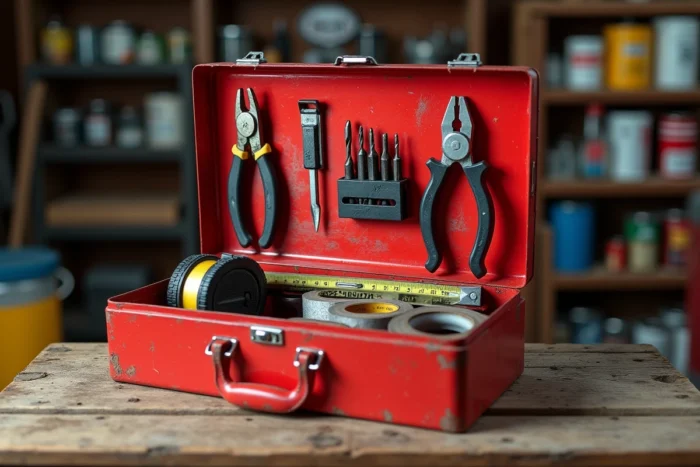
Before filling a toolbox, it is essential to distinguish three functional families. Striking and gripping tools (hammer, wrenches, pliers) are used for assembling or disassembling. Cutting tools (saw, cutter, shears) remove material. Measuring and marking tools (tape measure, level, square) ensure precision.
Recommended read : Tips and advice for easily maintaining and repairing your home equipment
This classification avoids a common pitfall: buying several tools that serve the same function while forgetting an entire family. A balanced home workshop covers all three families, even with a limited number of items.
To browse selections organized according to this logic, the equipment available on Ben Le Bricoleur classifies tools by usage rather than by brand, making the choice easier.
Read also : Discover the Douceur Enfance sitemap for easier navigation
Screwdrivers, wrenches, and pliers: the gripping trio that conditions everything else
The screwdriver is the most used tool in a home, and the one that most DIYers choose poorly. Two criteria matter: the type of tip (flat, Phillips, Pozidriv) and the size of the blade relative to the screw. A screwdriver that is too small will slip and round off the tip, making the screw impossible to remove later.
A set of four screwdrivers covers almost all domestic situations: a medium flat, a fine flat, a Phillips PH2, and a Pozidriv PZ2. Adding a socket screwdriver for hex head screws completes the kit without making it bulky.
Flat wrenches, socket wrenches, and Allen wrenches
Wrenches come in dozens of formats. To start, a set of mixed wrenches (flat on one side, open on the other) covering common sizes is sufficient for light plumbing, furniture assembly, and general maintenance. Allen wrenches, provided with most flat-pack furniture, deserve a dedicated set made of treated steel: the original wrenches bend quickly.
Adjustable pliers and cutting pliers
The adjustable pliers grip nuts, pipes, and fittings of various diameters thanks to their adjustable jaw. They temporarily replace a wrench when the exact size is missing. The cutting pliers, on the other hand, cut electrical wires, ties, and small nails. These two pliers serve distinct purposes and do not substitute for each other.
Sawing, fastening, and drilling: the tools that turn a project into reality
Cutting and fastening are the two actions that transition from plan to finished object. The choice of saw depends on the material, not the size of the piece.
- The hand saw with universal teeth is suitable for solid wood and particle boards up to a reasonable thickness. Its rigid blade provides a straight cut without a guide.
- The metal saw, with its fine blade stretched over a frame, cuts pipes, threaded rods, and aluminum profiles. It does not replace a wood saw and vice versa.
- The jab saw drills and cuts openings in drywall or thin wood, where a standard saw cannot start in the middle of a panel.
For fastening, a selection of plugs suitable for the substrate (concrete, hollow brick, drywall) is as crucial as the drill itself. An unsuitable plug for the wall will fail under load, regardless of the screw diameter.
Drill-driver: one tool, two functions
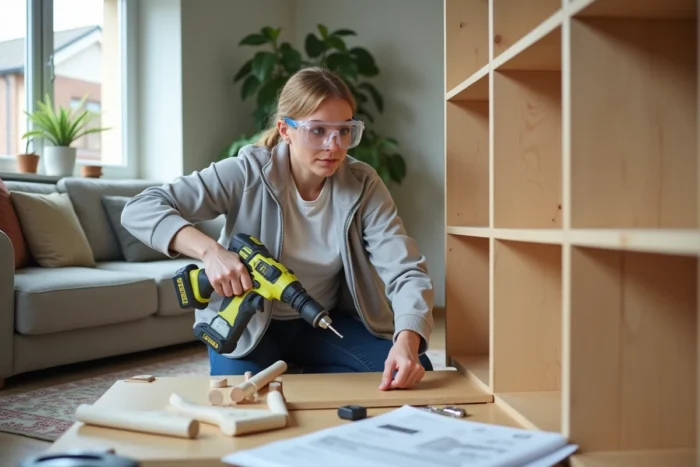
The cordless drill-driver combines drilling and screwing by alternating bits. The torque, expressed in newton-meters, indicates the screwing force. Insufficient torque will stall the tool before the screw is driven in, damaging the head and straining the motor. For common work in wood and drywall, a mid-range model with two speeds and a self-tightening chuck meets most needs.
Safety and storage: two often overlooked aspects of DIY equipment
Protective goggles, gloves suitable for the type of work, and hearing protection are not optional accessories. A metal projection in the eye during drilling or a deep cut with a saw can turn a productive afternoon into a trip to the emergency room.
- Wrap-around goggles also protect the sides of the face, unlike standard glasses.
- Cut-resistant gloves are suitable for handling sheet metal and glass but hinder fine screwing. Two pairs of different gloves are better than one mediocre all-purpose pair.
- A FFP2 dust mask is necessary as soon as sanding or cutting composite material generates fine particles.
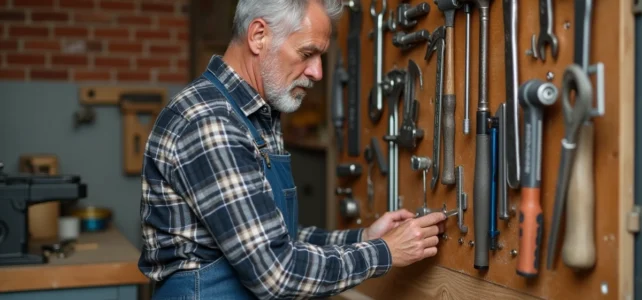
Storage affects the longevity of tools as much as their manufacturing quality. A screwdriver loose in a drawer will bend, a saw without a case will dull when in contact with other tools. Each tool stored in its place remains sharp and accessible. A drawer unit or a pegboard is sufficient for a home workshop.
Home DIY equipment does not require a huge budget or a professional garage. A coherent set of screwdrivers, wrenches, pliers, a suitable saw, a drill-driver, and safety equipment covers the vast majority of common tasks. The real criterion for choice remains the compatibility between the tool and the material, not the number of items in the toolbox.