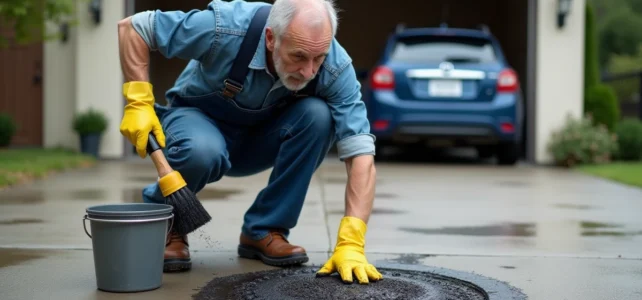
The black marks left by tires on a slab or concrete garage floor result from a transfer of material: the mechanical friction between the tire rubber and the mineral surface tears off micro-particles of rubber that settle in the pores of the concrete. The rougher or more porous the concrete, the more these residues embed themselves.
The problem is not merely a surface stain, which explains why a broom or a standard water jet is almost never sufficient.
You may also like : Trends and Tips for Successful Real Estate Investments in 2024
Why some tire marks resist standard concrete cleaning
The composition of tires plays a direct role in the difficulty of cleaning. Tires combine more than thirty types of materials, including synthetic rubber, carbon black, and various polymers. During braking, steering, or simply prolonged parking on a hot surface, these components soften and migrate into the roughness of the concrete.
Untreated, raw concrete acts like a mineral sponge. Its natural porosity traps rubber particles deep within, well beyond the visible layer. Light mechanical cleaning (brush and water) removes the surface layer but leaves intact the pigmentation embedded in the first few millimeters of the substrate.
See also : Tips and advice for easily maintaining and repairing your home equipment
On a garage or parking floor, the repetition of movements exacerbates the phenomenon. Each maneuver adds a layer of residues, and the heat generated by friction facilitates adhesion. Several practical guides help better understand how to remove tire marks from concrete while considering this embedding mechanism.
Degreaser, pressure washer, or chemical product: which method to choose
Not all cleaning methods are equal, and the choice primarily depends on the age of the mark and the type of concrete (raw, smoothed, painted, resin-coated).
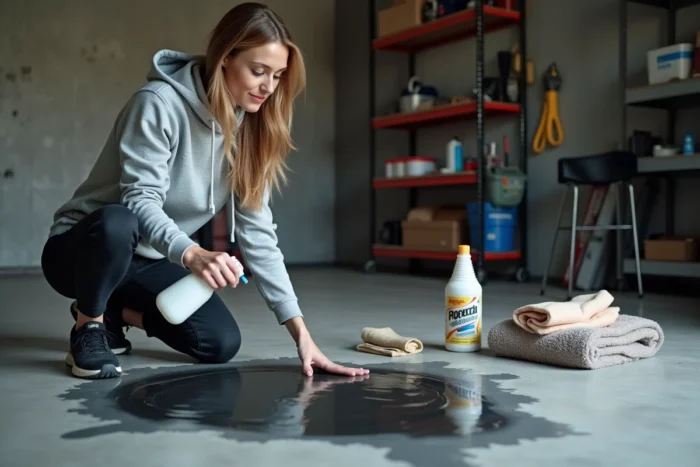
Alkaline degreaser or special tire mark foam
Manufacturers specializing in fleet maintenance offer degreasing foams formulated to dissolve tar, bitumen residues, and tire marks. These aerosols work through a chemical reaction and significantly reduce manual scrubbing time, preserving the surface of the concrete. The principle: spray, let it act for the time indicated by the manufacturer, then rinse with a jet.
This approach is particularly suitable for parking floors and car wash areas, where marks are frequent and extensive. However, on very old or cracked concrete, the product may penetrate into micro-cracks without being able to be rinsed properly.
Pressure washer on concrete
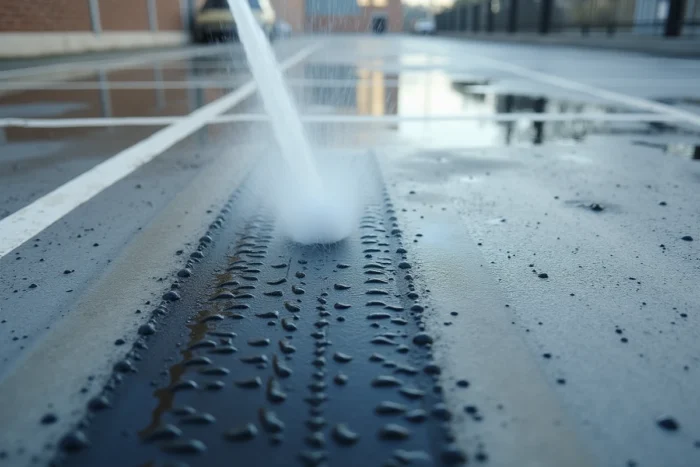
Pressure washing remains the most common method. Its strength lies in the mechanical action of the projected water, which dislodges rubber particles trapped in the pores. For effective results, a few points must be respected:
- Use a rotating nozzle (called “turbo”) rather than a flat jet, to concentrate power on the soiled area without dispersing dirt around
- Maintain a distance of at least 15 to 20 centimeters between the nozzle and the ground, or risk eroding the surface layer of the concrete
- Work in regular passes and not by insisting on a single point, which would unevenly erode the substrate
The pressure washer alone is not sufficient for old marks. Combining a pre-treatment with a degreaser with a pressure rinse yields better results than either method alone.
Diluted bleach and acidic solutions
Diluted bleach is often cited as a home remedy. It acts on the discoloration of the visible mark but does not actually dissolve the embedded rubber. The result is cosmetic: the stain lightens without completely disappearing.
Acidic solutions (diluted hydrochloric acid, concentrated white vinegar) attack the surface of the concrete itself. They may work on light marks, but risk discoloring or altering the texture of the concrete irreversibly. A test on a less visible area remains the minimum precaution before any application.
Protecting concrete to avoid recurring tire marks
Cleaning an embedded mark takes time and stresses the substrate. The real question, rarely asked in cleaning guides, concerns the preventive protection of concrete.
Raw concrete left untreated accumulates dirt much faster than treated floors. There are two main options to reduce the adhesion of rubber residues.
- The application of a water-repellent or colorless pore filler, which reduces surface porosity without altering the appearance of the concrete. This treatment does not prevent marks but significantly facilitates their subsequent cleaning
- The installation of a floor resin (epoxy or polyurethane type), which creates a physical barrier between the tire and the concrete. A resin floor can be cleaned with a mop, without chemicals or high pressure
- Using specific garage floor paints, which are less durable than resin but more accessible in terms of cost and implementation
Field feedback varies on the durability of these treatments depending on traffic. A residential garage with a single vehicle retains a water-repellent treatment for several years. A high-traffic parking lot requires more frequent renewal, and resin remains the most sustainable choice.
Decorative concrete, paving stones, and special surfaces: the traps to know
Tire marks are not treated the same way on smoothed concrete, exposed aggregate concrete, interlocking pavers, or painted slabs. Each finish reacts differently to products and mechanical methods.
On exposed aggregate concrete (visible aggregates), rubber residues lodge between the reliefs. The pressure washer works well here, as the water seeps into the hollows. A prior degreaser improves the result.
On concrete pavers, the difficulty comes from the joints. Liquid products migrate into the joint sand and can destabilize it. It is better to favor a low-drip foam and targeted brushing rather than an aggressive high-pressure jet.
On painted or waxed concrete, any acidic product or strong solvent risks destroying the coating along with the mark. A mild degreaser, tested on a discreet corner, remains the only reasonable approach.
The choice of method thus depends as much on the type of mark as on the type of concrete. Applying an acid on waxed concrete or projecting high pressure on fragile pavers creates more visible damage than the mark itself. Precisely identifying the substrate before acting avoids unpleasant surprises.