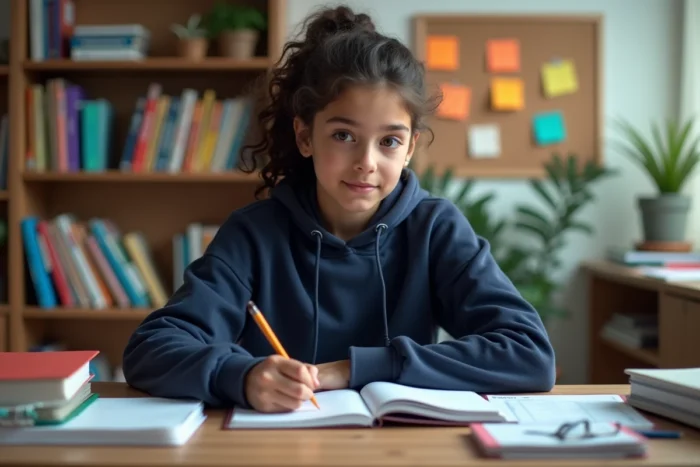
Success in high school relies on a simple mechanism: the consistency of personal work, calibrated to the rhythm of continuous assessment and specialty exams. Since the reform of the baccalaureate, each term contributes to the final grade. The ability to establish stable habits from the first weeks conditions the rest far more than the intensity of last-minute revisions.
Active review on the same day: the most underestimated lever in high school
Feedback from tutors and institutions converges on one point: reviewing your course on the same day for 20 to 30 minutes massively reduces cramming before exams. This practice does not consist of skimming through notes. It involves reformulating the main ideas, asking questions about unclear points, and testing understanding through a mini-exercise or a quick diagram.
The benefit is twofold. First, memory consolidates information during the sleep that follows learning, so an evening review directly exploits this mechanism. Second, gaps appear immediately when the course is still fresh, allowing for questions to be posed to the teacher the very next day instead of discovering the problem the night before the test.
This daily reflex distinguishes high school students who gradually accumulate their revisions from those who find themselves overwhelmed as exams approach. To delve deeper into this logic of regular work, Mindtrap’s tips for success in high school detail how to adjust effort according to the difficulty level of each year.
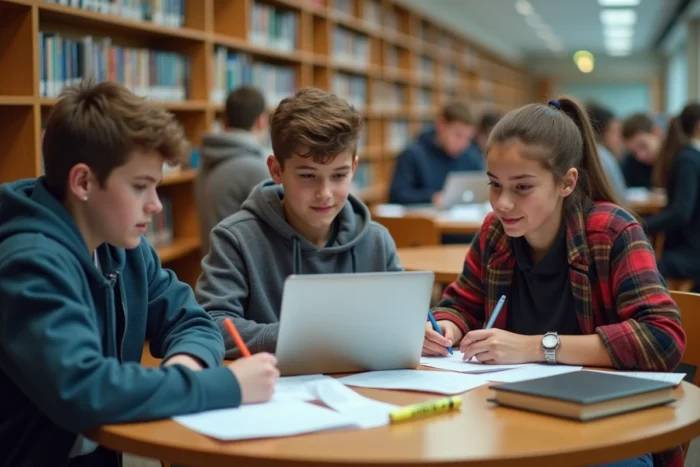
Quarterly planning and continuous assessment: organizing revisions in blocks
Continuous assessment now represents a significant portion of the baccalaureate grade. Each monitored assignment, each specialty evaluation counts towards the final calculation. Working in bursts no longer works: a quarterly organized plan replaces the final sprint.
Specifically, each term can be divided into three distinct phases:
- The first weeks are used to deeply assimilate new concepts, with daily review as the foundation.
- The middle of the term is the time to intensify practice on typical subjects, especially in specialties, to identify weak points before they become fixed.
- The last weeks before the class council are used to consolidate knowledge through summary sheets and timed exercises, without discovering new methods.
This division avoids the trap of “revising everything in the last week.” Students who stick to it describe a significantly higher sense of mastery as they approach the specialty exams in March, both in First and Terminale.
Adapting the plan to coefficients
Not all subjects carry the same weight in the baccalaureate. Identifying the highest coefficients allows for more revision time to be allocated to chosen specialties without neglecting the core curriculum. An effective plan reflects this hierarchy rather than distributing time evenly.
Smartphone and concentration: the variable most high school students overlook
In recent years, surveys of French high school students have shown a strong correlation between unregulated smartphone use in the evening and declining results. The mechanism operates through two channels: the reduction of actual sleep time and the fragmentation of attention during personal work phases.
The problem is not limited to time spent on social media. Notifications, even briefly checked, interrupt the memorization process. Regaining concentration after a few seconds of interruption takes several minutes, which artificially extends the duration of assignments and gives the impression of working hard for little result.
Implementing a structured break
Rather than aiming for total abstinence (rarely sustainable), a pragmatic approach is to define a time slot without a phone during schoolwork. Placing the device in another room, on silent mode, during the review or revision session is enough to restore blocks of continuous concentration.
Sleep also plays a role in the equation. Turning off screens at least 30 minutes before sleeping improves sleep quality, and thus the ability to memorize the next day. This detail, often perceived as generic health advice, has a direct and measurable impact on academic performance in high school.
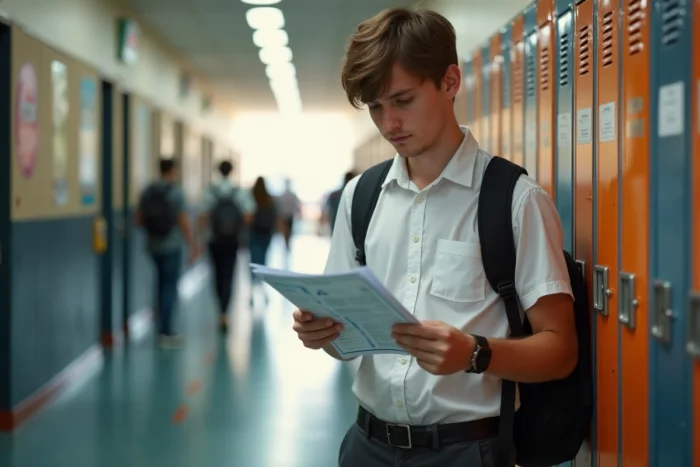
Stress management and exam preparation for the baccalaureate
Stress before an exam is not a character flaw. It is a normal reaction that the brain produces in response to a perceived high stake. The difference between paralyzing stress and mobilizing stress lies in the preparation beforehand.
A student who has regularly reviewed their courses, organized their revisions by term, and preserved their sleep arrives at the exams with a solid foundation. Stress still exists, but it is no longer fueled by uncertainty about the content. Confidence is built on repetition, not motivation.
The weeks before the exam
The final stretch should not be used to learn new content. It serves to activate what has already been worked on. The revision sheets created throughout the year then become a tool for quick review rather than a writing project. Revising for the baccalaureate starts in the first term, not in May.
Practice on past papers, conducted under real conditions (time-limited, no notes), helps to identify acquired reflexes and those still lacking. Two or three complete subjects per specialty in the weeks leading up to the exam are enough to calibrate writing pace.
The high school year is played out through simple actions repeated consistently. Evening review, planning adjusted to coefficients, smartphone management, and gradual preparation for exams form a coherent system. None of these elements require particular talent, but each produces cumulative effects that last-minute cramming cannot replicate.