
The salt treatment is based on a simple principle: the electrolyzer transforms dissolved salt into active chlorine, which disinfects the water before turning back into salt. This closed cycle limits the addition of chemical products, but it assumes that the salt is correctly introduced into the pool.
The concentration recommended by most electrolyzer manufacturers is between 3 and 7 g per liter of water, depending on the model. Even a modest deviation can reduce the efficiency of the cell or trigger a low salinity alarm. The issue of dosage is well documented. However, the question of where and when to add the salt is much less so.
Read also : How to Keep Your Guests Entertained During the Wedding Photo Session: Ideas and Tips
Overflow Pool and Buffer Tank: A Common Pouring Mistake
Most guides recommend distributing the salt “in the pool.” This instruction works for a standard pool with skimmers. It becomes misleading for an overflow pool.
In this type of installation, water continuously circulates from the main pool to a buffer tank, where the pump draws in before returning the filtered water. Pouring salt into the buffer tank sends over-salted water directly into the circuit and the electrolyzer cell, without sufficient dilution. The risk: a temporary overload on the electrodes and a distorted reading from the salinity probe.
You may also like : How to Safely Connect White and Black Wires
The salt should be added to the main pool, away from the overflow gutter, so that dilution occurs gradually before the water reaches the suction circuit. A guide detailing where to put salt in a pool according to Murmures Déco emphasizes this distinction, which is often missing from manufacturer instructions.
Distance for Adding and Areas to Avoid in the Pool
Even in a skimmer pool, the precise location where the salt is poured affects the quality of dissolution. The common reflex is to empty the bags from the most accessible coping, sometimes just above a skimmer or a main drain. This practice concentrates the salt where the suction is strongest.
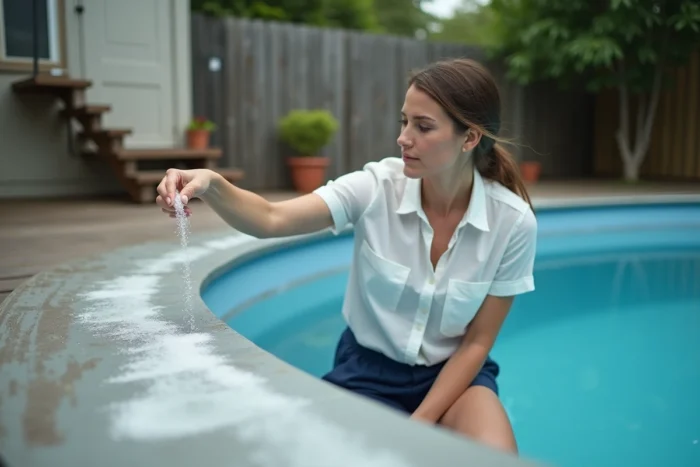
Feedback from pool professionals on specialized forums points to a finer rule: pour the salt as far away as possible from the main drains and skimmers. The goal is to allow the salt to dissolve in the body of water before it is drawn into the cell. In a rectangular pool, the deep end (the side opposite the skimmers) generally offers the best area.
Three practical guidelines guide the pouring:
- Distribute the salt around the perimeter of the pool rather than in a single spot to avoid pockets of concentration at the bottom.
- Never pour directly into the skimmers or vacuum inlets, which would send undissolved salt into the plumbing.
- Maintain a distance of at least one to two meters from the main drain, especially if the filtration is already running.
Once the salt is poured, the filtration must run continuously for at least 24 hours without activating the electrolyzer. This delay allows for complete dissolution, even when the water temperature is still cool at the beginning of the season.
What Time of Day to Add Salt to Your Pool
Electrolyzer manuals rarely mention the time slot. Field feedback converges on a logical recommendation: add the salt in the early morning, with filtration running. Water circulation is then at its maximum for several consecutive hours before any nighttime pump shutdown.
Pouring salt in the late afternoon or evening exposes you to a simple problem. If the pump stops at night (a typical timer setting), the undissolved salt settles at the bottom and can form clumps. These deposits slow down dissolution and create areas of over-concentration in contact with the liner or coating.
On the other hand, if your pump runs 24/7 during the startup period, the time slot matters less. The determining factor remains the continuous circulation time after the addition.
Pool Salt vs. Water Softener Salt: The Confusion That Damages Electrodes
The salt sold in hardware stores comes in several categories. De-icing salt, water softener salt, pool salt: the bags look similar, prices differ, and so do the compositions.
Salt suitable for pool electrolysis meets specific criteria:
- High purity, without anti-caking additives, iodine, or fluoride, which can clog the electrolyzer cell.
- Appropriate granule size (tablets or large crystals) for gradual and consistent dissolution.
- Compliance with standard EN 16401, specifically designed for pool electrolysis.
Tablet water softener salt may seem identical. It is sometimes pure to an acceptable level, but it often contains compression binders that leave a whitish residue on the electrodes. In the medium term, these deposits reduce the active surface of the cell and decrease chlorine production.
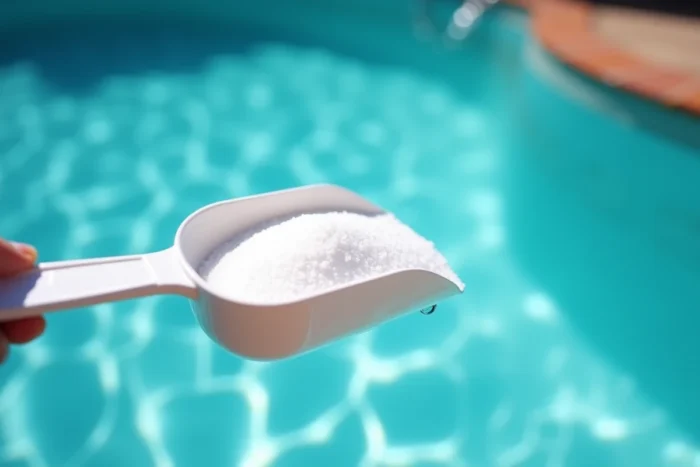
De-icing salt, less refined, contains mineral impurities (iron, manganese) that can color the water or stain the coating. Its lower price per kilo does not compensate for the costs of recovery.
Checking Salt Levels After Addition: What Test Strips Don’t Tell You
After 24 hours of filtration, measuring the salt level determines whether the electrolyzer can be restarted. Most owners use test strips or rely on the built-in probe of their device.
Test strips provide a rough estimate, not a precise measurement. Their margin of error can reach one gram per liter, which represents a significant deviation when the operating range of the electrolyzer is narrow. An electronic salinity tester offers a more reliable reading, for a modest investment.
The built-in probe of the electrolyzer, on the other hand, measures the conductivity of the water, not directly the salinity. Water rich in minerals (calcium, magnesium) can skew the reading upwards. If your fill water is hard, the value displayed on the device may overestimate the actual salt level.
Before correcting a deemed insufficient level, checking with a second measuring device avoids adding salt unnecessarily. An excess of salt can only be removed by partial draining, which represents a much more costly waste of water and time than a simple control measurement.