
A Faac gate that refuses to move after a power cut or motor failure presents a concrete problem: accessing or exiting your property. Before contacting a repair technician, most Faac automations include a manual unlocking mechanism designed for such situations. Understanding the logic of this mechanism, identifying the correct model, and applying the right procedure prevents forcing a leaf or damaging the motor.
Gate-safe or gate-secure configuration: what changes during a failure
Faac offers two security philosophies for its hydraulic operators for swing gates (notably models 402 and 422). This distinction directly affects what happens when the power goes out.
Further reading : Complete guide to placing an order on Amazon and avoiding mistakes
| Configuration | Behavior during a power cut | Main advantage | Main constraint |
|---|---|---|---|
| Gate-safe | The magnetic lock automatically unlocks | Immediate manual access, without a key or manipulation | Reduced anti-intrusion level during the cut |
| Gate-secure | The electric lock remains locked | Protection against intrusions maintained | Manual unlocking required with the release key |
In gate-safe configuration, the gate releases itself during the power cut. You just need to push or pull the leaf by hand. In contrast, a gate in gate-secure mode remains blocked until the unlocking procedure is performed manually.
Identifying the active configuration on your automation is therefore the first step. This information is found in the motor’s installation manual, often in the chapter dedicated to lock settings. If you had your gate installed by a professional, they should have made this choice during the initial setup.
Related reading : How to Easily Succeed in High School: Essential Tips and Tricks
To know exactly how to unlock a Faac electric gate according to your model, the procedure varies between an arm operator, a hydraulic cylinder, or a sliding motor.
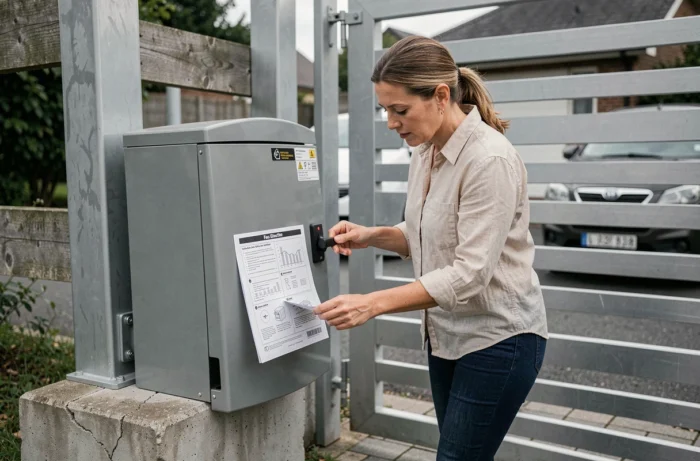
Faac release key: location and use according to the type of motor
All Faac motors are equipped with a release system accessible by key. The mechanism disconnects the motor from the gate, allowing the leaf to be moved by hand.
Swing gate with hydraulic operator
On models 402, 422, or 391, the unlocking lock is located directly on the body of the operator, protected by a rubber cap or a screwed plug. The key provided at installation allows for a quarter turn or a half turn depending on the model to release the hydraulic piston.
- Remove the protective cap from the motor housing
- Insert the release key and perform the rotation indicated in the manual (usually a quarter turn)
- Push or pull the leaf manually to the desired position
- After power restoration, turn the key in the opposite direction to re-engage the motor
One point not to be overlooked: relocking after repair is essential. A gate left in release mode no longer responds to the remote control and remains vulnerable.
Sliding gate
On Faac sliding motors (C720 or C721 range), the principle remains the same. The release lock is located on the side housing of the motor. The rotation of the key releases the drive pinion, allowing the gate to slide on its rail without mechanical resistance.
The main difference with a swing gate: a released sliding gate can roll freely on the rail. It must therefore be wedged or held in the open position to prevent it from closing due to wind or a slight slope.
Lost release key: concrete solutions
The release key is a small item often stored away after installation and sometimes impossible to find years later. This situation is common and blocks manual unlocking on gate-secure configurations.
Several options exist depending on the urgency:
- Order a replacement key from an authorized Faac dealer, specifying the exact reference of the operator (engraved on the motor housing)
- Contact a locksmith specialized in automations, who can pick the release lock without damaging the mechanism
- As a last resort, a gate motor technician can partially disassemble the housing to access the internal release mechanism
Forcing the lock with an unsuitable tool risks breaking the cylinder and rendering the release system permanently unusable. The cost of a complete replacement of the unlocking block far exceeds that of a new key.
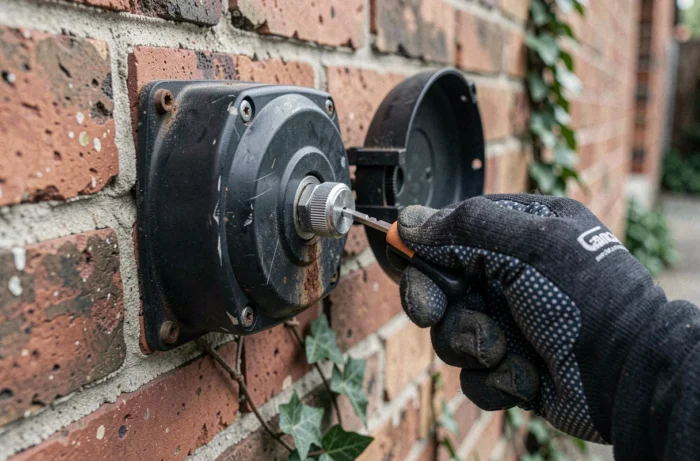
Annual verification of closing forces: an often-overlooked obligation
Motorized gates, including those equipped with Faac automations, are subject to European standards (DIN EN 12453) that require annual verification of closing forces by a competent person. This measure must be recorded in a testing protocol.
The link to unlocking is direct: a motor whose forces are not properly calibrated can cause a mechanical blockage that prevents both automatic operation and manual maneuvering. A leaf that forces against an obstacle not detected by the photocells can misalign the arm or cylinder, making release more difficult.
Having this annual verification performed by an installer also allows testing the proper functioning of the manual unlocking mechanism and ensuring that the release key is always accessible and operational.
Swing or sliding: summary of Faac unlocking differences
| Criterion | Swing gate (402, 422, 391) | Sliding gate (C720, C721) |
|---|---|---|
| Lock location | On the body of the operator (arm or cylinder) | On the side housing of the motor |
| Released mechanism | Hydraulic piston | Drive pinion |
| Risk after release | Leaf free, held by its weight | Gate can roll on the rail (wind, slope) |
| Relocking | Reverse rotation of the key | Reverse rotation of the key |
Unlocking a Faac gate relies on a simple mechanism but requires knowledge of its configuration (gate-safe or gate-secure) and keeping the release key accessible. Testing this procedure once a year, during the mandatory verification of closing forces, remains the most reliable way to avoid being stuck when the power goes out.