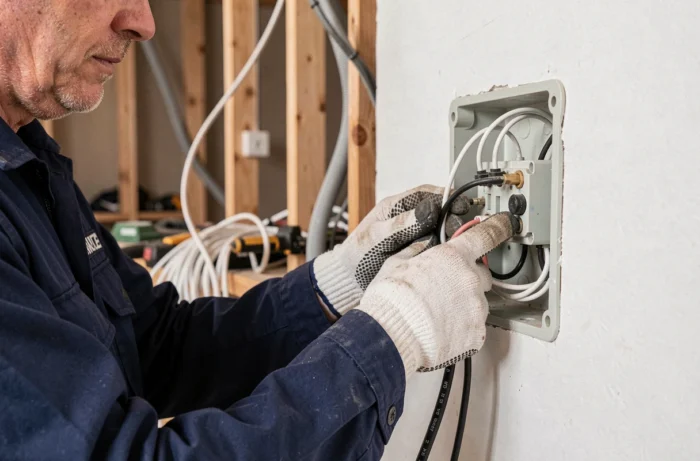
On a a renovation site or faced with an old ceiling light, one often encounters black and white wires without any labels. The classic reflex is to associate black with the phase and white with the neutral, but this shortcut can lead to dangerous wiring errors, especially in installations made before the year 2000. Successfully connecting the white and black wires requires checking each conductor before connecting anything.
Black wire and white wire: why color alone is no longer enough to identify a conductor
In a recent installation compliant with the NF C 15-100 standard (2024 edition, mandatory since September 1, 2025), colors are strictly assigned. Light blue is reserved for neutral, green/yellow for earth, and the phase uses red, brown, or black. White and gray are limited to specific uses such as control or signaling.
The problem arises during renovations. In older homes, the white wire was commonly used as neutral, sometimes as a return for control. A black wire could be the phase or a traveler for a two-way switch. Color is just a clue, not proof. One cannot rely on it without measurement.
Before connecting anything, a multimeter or voltage tester (VAT) is used to formally identify each conductor. By placing the tip of the multimeter between the suspect wire and the earth, a voltage around 230 V confirms the phase. The absence of voltage indicates the neutral. Mastering the connection of white and black wires starts with this systematic verification step, regardless of the age of the home.
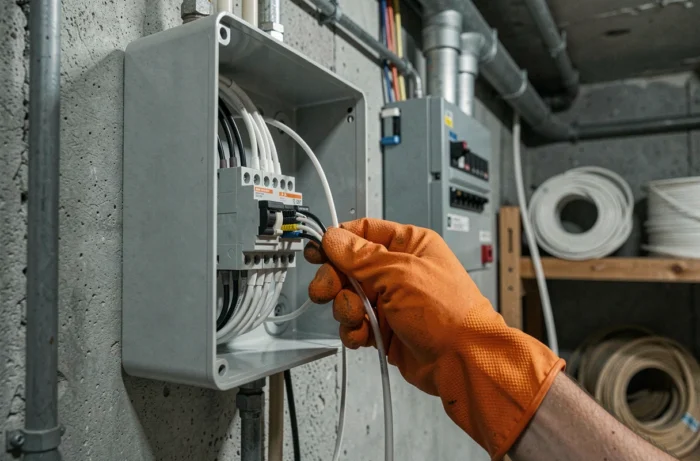
Multimeter check: the field method before any electrical connection
Cutting power at the main circuit breaker is the first step. Then, check for the absence of voltage with the VAT directly on the wires in question. It is only after this confirmation that one handles the conductors with bare hands.
To identify the phase once power is restored (and only at that moment), proceed wire by wire:
- Set the multimeter to AC 250 V or higher, place one probe on the wire to be tested and the other on the earth or green/yellow wire. A reading close to 230 V identifies the phase.
- Test the second wire in the same way. A reading close to 0 V between this wire and the earth confirms the neutral.
- If three wires come out of the box (black, white, and a third), also check the voltage between each pair. A traveler wire for a two-way switch will show 0 V when the switch is open and 230 V when it is closed.
Never deduce the function of a wire by elimination. Each conductor is tested individually. Feedback varies on this point, but in older installations, a white wire can very well carry the phase if the previous electrician used what was on hand.
Safe connection of electrical wires: terminals, tightening, and common mistakes
Once each wire is identified and labeled (a piece of colored tape is sufficient), one proceeds to the actual connection, with the power off.
Choosing the connector according to the cable section
Ceramic or plastic terminal blocks remain common, but automatic terminals like Wago offer more reliable contact and save time. The stripped wire is inserted, and the internal spring maintains pressure. For sections of 1.5 mm² (lighting) or 2.5 mm² (outlets), Wago terminals from the 221 series accept both sizes without an adapter.
Each terminal must receive wires of the same section. Mixing 1.5 mm² and 2.5 mm² in the same connector causes poor contact that can heat up and ultimately cause an electric arc.
Stripping and length of exposed copper
The wire is stripped to the length indicated by the connector template (generally 10 to 12 mm for an automatic terminal). If too short, the wire does not insert completely. If too long, bare copper protrudes from the connector and creates a risk of short circuit in the junction box.
A calibrated wire stripper should be used rather than a cutter. Notching the copper weakens the conductor and increases its resistance at the contact point.

Wiring errors between phase and neutral: concrete consequences for safety
Reversing the phase and neutral on an outlet does not trip the circuit breaker. The connected device will function normally in most cases. This is precisely what makes the error insidious.
A device whose neutral is actually the phase remains energized even when turned off. The metal casing of a light fixture or the chassis of an appliance can then become conductive in case of insulation failure. The 30 mA differential protects against electric shocks, but a phase-neutral reversal cancels the safety cut-off of certain single-pole switches.
On a lighting circuit with a simple switch, the switch must always cut the phase, never the neutral. If the black wire arriving at the switch is actually the neutral (because an old wiring has affected it that way), the bulb remains powered with a permanent phase even when the switch is open. Changing a bulb under these conditions exposes one to the risk of electric shock.
When to call in a professional electrician
Replacing a light fixture or outlet on an existing and correctly identified circuit is accessible with a multimeter and suitable connectors. However, certain situations exceed the scope of regular DIY:
- Three or more wires come out of the wall without identification, and multimeter tests yield inconsistent results (intermediate voltages, presence of voltage on the earth wire).
- The installation does not include an earth wire (green/yellow absent), which requires compliance of the circuit before any connection.
- The electrical panel does not have a 30 mA differential circuit breaker on the concerned circuit.
- Intervention on a three-phase circuit or on the connection to the panel itself.
A diagnosis by a certified professional allows mapping of the conductors, identifying anomalies inherited from previous work, and bringing the installation into compliance with the current NF C 15-100 standard.
The black wire is not always the phase, and the white wire is not always the neutral. Placing a multimeter on each conductor before tightening any terminal remains the only action that guarantees a reliable connection, regardless of the age of the home.