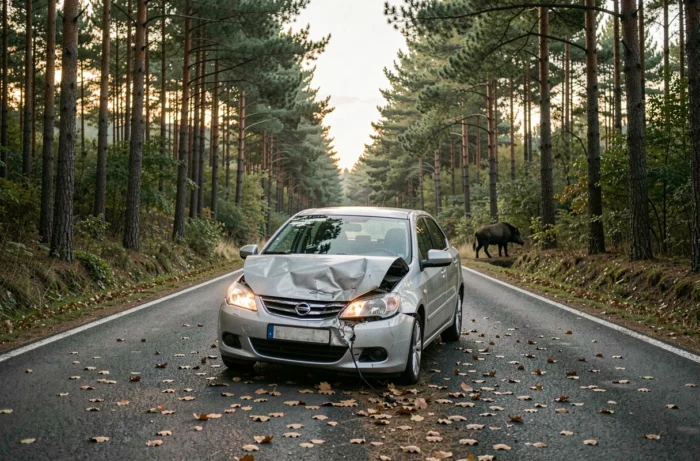
A wild boar weighing several dozen kilos suddenly appears in front of the hood; the collision lasts a fraction of a second, but the consequences stretch over weeks. Between the roadside, the report to write alone, and the exchanges with the insurer, every step counts to avoid losing compensation. Here’s how to manage an accident with a wild boar, from the asphalt to the claim file.
Securing the area after a collision with a wild boar
This is not a classic bump between two vehicles. A wild boar hit at moderate speed can deform a bumper, explode a radiator, or block the steering. The first reflex is to assess whether the vehicle can still drive.
If the car is immobilized, turn on the hazard lights and place the warning triangle at a sufficient distance, especially at night on an unlit road. Exit the vehicle from the side away from traffic, wearing a reflective vest.
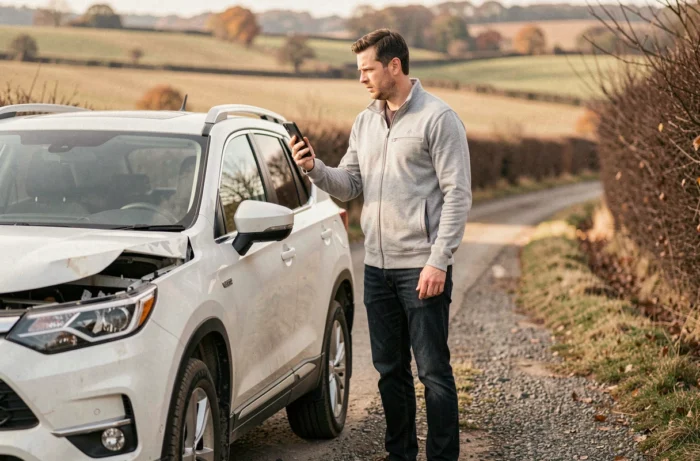
The animal may still be alive. Never approach an injured wild boar: even on the ground, it can charge or bite. Call the gendarmerie, who will contact a hunting lieutenant or a gamekeeper to intervene if necessary. This is also the time to photograph the scene, the damage to the vehicle, the position of the animal, and the marks on the road.
When managing an accident with a wild boar in a car, these visual proofs taken on-site form the basis of the compensation file. Without them, the insurer may dispute the nature of the claim.
Claim declaration and five working days deadline
The legal deadline to declare the claim to the insurer is five working days from the date of the accident. After this period, coverage may be refused or reduced. This is not advice; it is a standard contractual clause.
Documents to gather for the file
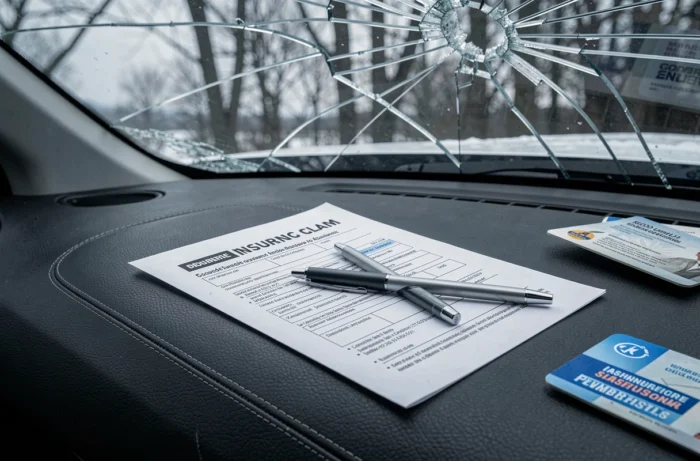
A solid file speeds up processing. Here’s what to collect before contacting the insurer:
- The report or receipt of the complaint issued by the gendarmerie, which attests to the nature of the accident (collision with a wild animal)
- Photos taken on-site: damage to the vehicle, traces of blood or hair, road environment
- The amicable report filled out alone (by checking the box “one vehicle involved”), with a sketch of the situation
- The registration certificate and the details of the auto insurance contract
Send the declaration by registered letter with acknowledgment of receipt, even if the insurer accepts an online or phone declaration. The registered letter creates a proof of date, and it is the only one that holds in case of dispute.
Why call the gendarmerie, not just the insurance
The gendarmerie is not there for the report in the classic sense. But their intervention generates a report that classifies the event as a collision with a wild animal. Without this document, the insurer could reclassify the claim as a simple road departure, which changes the coverage according to the contract’s guarantees.
Auto insurance and compensation: what the contract really covers
Not all auto insurance contracts handle this type of claim in the same way. The distinction lies in one specific point: the collision with a wild animal falls under the “collision damage” or “comprehensive” coverage, not just liability insurance.
With third-party insurance, you receive nothing for material damage to your own vehicle. Third-party insurance covers damage caused to others, not to oneself. To obtain compensation for repairs, you must have at least collision damage coverage, or better, comprehensive coverage.
Deductible and impact on the no-claims bonus
A deductible applies in most contracts. Its amount varies according to insurers and plans, so check the specific conditions before starting the procedure. An accident with a wild boar does not result in a penalty: the collision with a wild animal is classified as a claim without an identified third party, which preserves the reduction-increase coefficient.
This is a point that many drivers are unaware of and prevents them from hesitating to declare for fear of seeing their premium increase.
Recourse against a third party and the role of the FGAO
In most cases, no one is identified as responsible: the wild boar has no owner. The driver bears the deductible and relies on their own contract. Two exceptions deserve to be known.
If hunters were in action and the animal crossed the road fleeing from a hunt, the responsibility of the hunting society or the departmental federation may be engaged. Document this point with the gendarmerie report and, if possible, testimonies.
If no warning sign alerted to the presence of game on a stretch known for animal crossings, the road manager (State, department, municipality) may be held liable for lack of maintenance or signage.
When none of these avenues lead to a solution and the driver does not have sufficient coverage, the Guarantee Fund for Mandatory Damage Insurance (FGAO) may intervene to compensate bodily injuries. This recourse is limited to physical injuries and requires the establishment of a specific file.
Reducing the risk of collision with a wild animal
Approximately 40,000 collisions between vehicles and wild animals occur each year in France. The wild boar population continues to grow: for the 2024-2025 season, about 881,372 wild boars were culled, a record increase of about 2% year-on-year.
The most exposed areas are roads bordered by forests and fields, particularly at dawn and dusk. Reducing speed at dusk in wooded areas remains the most effective measure. An adult wild boar can weigh over one hundred kilos: at 90 km/h, the energy of the impact is enough to deform the entire front end of a vehicle.
When a triangular sign indicates the passage of game, ease off the accelerator and scan the roadside. If an animal appears in the headlights, brake in a straight line without making a sudden steering movement. Swerving to avoid the wild boar often ends up in the ditch or head-on, with consequences more severe than the collision itself.
A good contract, a quick declaration reflex, and adapted driving in risk areas form the triptych that makes the difference between a well-managed claim and a dispute that drags on.